
Featured Article
Industry Solutions
INTRODUCTION
AI isn’t just enhancing dentistry — it’s redefining how multi-clinic networks operate, scale, and deliver consistent care.
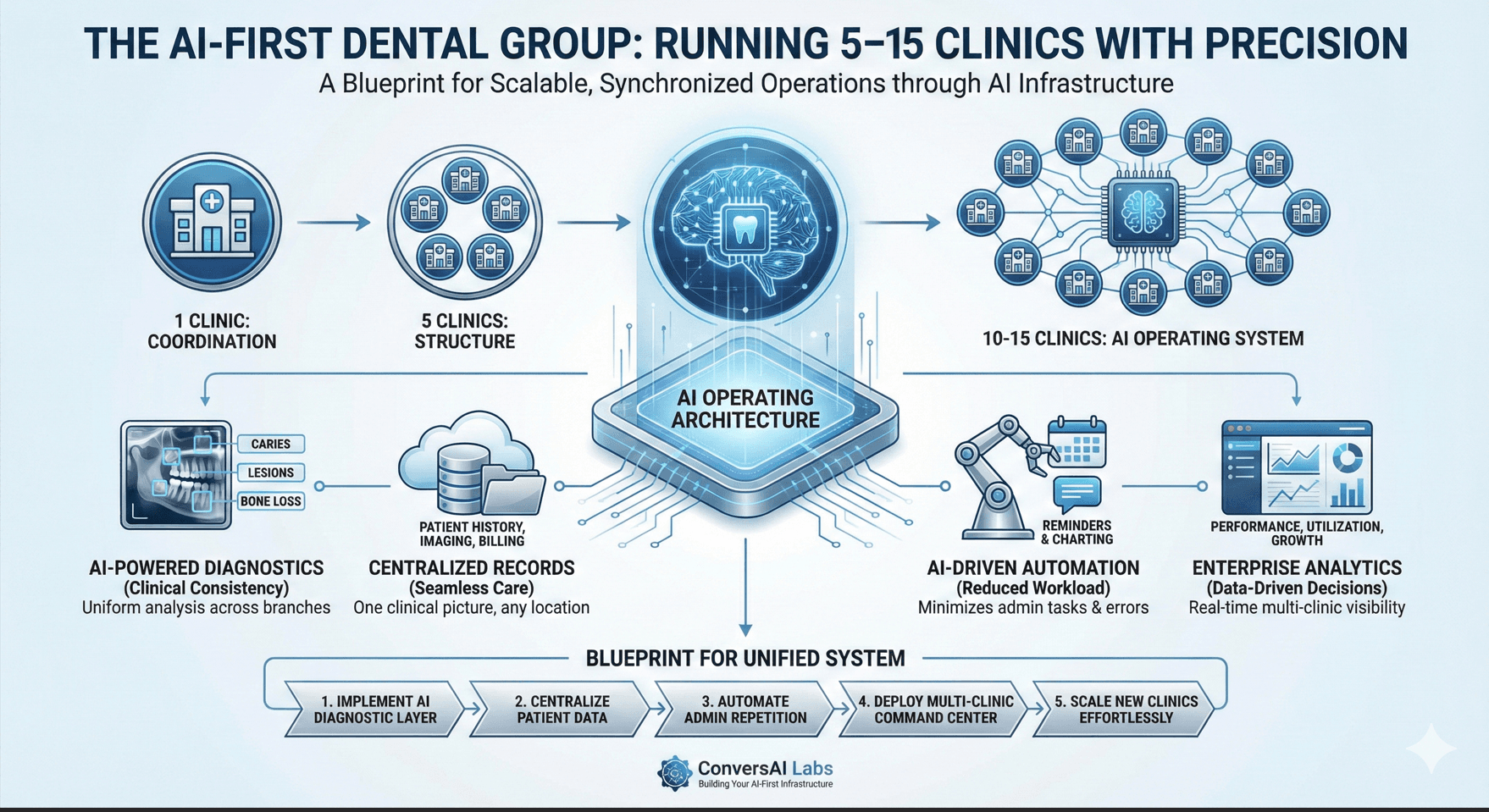
Running one dental clinic requires coordination.
Running five requires structure.
Running ten or fifteen clinics - each with unique staff, patient demographics, and operational quirks - requires an entirely new operating system for dentistry.
That operating system is AI.
Dental chains across the world are discovering that AI isn’t merely a tool for diagnostics - it is the invisible infrastructure that synchronizes multi-location operations, enforces clinical consistency, eliminates administrative burden, and unlocks exponential growth.
This blueprint explains how AI enables dental groups to operate 5–15 branches with the precision, quality control, and responsiveness of a single, perfectly optimized clinic - backed by real research and enterprise-oriented insights.
1. Why Traditional Multi-Clinic Models Break at Scale
Most groups grow from 2 clinics → 4 clinics → 7 clinics organically.
But growth introduces complexity faster than revenue.
The biggest breaking points:
• Clinical inconsistency
Different doctors = different diagnoses, treatment plans, charting accuracy, and radiographic interpretation.
• Fragmented patient records
Paper files, disconnected PMS systems, local hard drives, unshared imaging → chaos.
• Scheduling inefficiency & rising no-shows
More clinics mean more human error, more manual reminders, more admin hours.
• No unified performance visibility
Owners cannot answer essential questions across branches:
--Which clinic is underperforming?
--Which dentist has highest case acceptance?
--Where is revenue leaking?
Where is chair-time being wasted?
• Staff burden grows exponentially
Admin staff rise clinic-by-clinic, limiting profitability.
Even top-performing groups feel these operational bottlenecks.
This is where AI provides a new operating architecture.
2. The Rise of AI-Driven Dentistry: What the Industry Data Shows
AI adoption in dental enterprises is accelerating because evidence is overwhelming.
• Market Growth
The global AI-in-dentistry market is projected to reach USD 3.1B by 2034, growing at 22.3% CAGR.
Source: InsightAce Analytics (2024)insightaceanalytic.com
• Diagnostic Accuracy
AI models for radiology and oral pathology have shown >90–95% accuracy in detecting caries, bone loss, and lesions.
Source: Frontiers in Dental Medicine, 2023 frontiersin.org
• Workflow Efficiency Gains
AI systems can reduce administrative workload by 20–35% and speed up case documentation significantly.
Source: MDPI Biomedical Engineering Review (2024)mdpi.com
The message is clear:
AI is not an add-on. It is the backbone for scalable multi-clinic operations.
3. What an AI-First Dental Group Actually Looks Like
Imagine a dental network with 10 clinics across different neighborhoods or cities.
Instead of 10 separate entities, the AI-First Dental Group runs like one synchronized organism.
Here’s how:
A. AI-Powered Diagnostics Create Clinical Uniformity
AI models analyze radiographs uniformly across all clinics, detecting:
1.Caries
2.Periapical lesions
3.Periodontal bone defects
4.Restorative failures
This eliminates variability and standardizes care quality.
Every clinic now operates with the same diagnostic benchmark.
B. Centralized Records Enable Seamless, Multi-Location Care
No more fragmented data.
AI-backed systems unify:
1.Imaging
2.Treatment history
3.Chart notes
4.Periodontal charts
5.Billing records
A patient can walk into any branch - and the dentist sees a complete clinical picture instantly.
C. AI-Driven Automation Reduces Non-Clinical Workload
Automation handles:
1.Appointment reminders
2.Treatment follow-up prompts
3.Radiograph labeling
4.Documentation assistance
5.Charting suggestions
This reduces staff dependency and minimizes errors.
D. Enterprise Analytics for Multi-Clinic Decisions
AI dashboards show:
1.Clinic-level performance
2.Dentist-level case acceptance
3.Chair-time utilization
4.Treatment mix distribution
5.Predictive patient demand
6.No-show patterns
The organization becomes data-driven, not intuition-driven.
Global AI-in-Dentistry Market Growth
Year Market Value Source
2024 $421M InsightAce Analytics
2034 (Projected) $3.1B InsightAce Analytics
CAGR 22.3% Verified Report
Source: insightaceanalytic.com
Proven AI Accuracy in Diagnostics
Studies show AI detects dental conditions with accuracy reaching 90–95%+, improving both speed and reliability.
Source: Frontiers in Dental Medicine (2023)dental-medicine
AI Reduces Admin Burden by 20–35%
Source: MDPI Biomedical Engineering Review (2024)www.mdpi.com
AI is no longer an experiment — it is infrastructure.
4. A Blueprint for Running 5–15 Clinics as One Unified System
Here is the exact operational blueprint AI enables:
Step 1: Implement AI Diagnostic Layer
All branches use the same AI engine for radiograph analysis → clinical consistency.
Step 2: Centralize Patient Data
Move all clinics into a unified AI-ready data environment.
Step 3: Automate Administrative Repetition
Scheduling, reminders, documentation → automated across the network.
Step 4: Deploy a Multi-Clinic Command Center
Management gets real-time dashboards for:
--Revenue tracking
--Operational efficiency
--Quality audits
--Dentist performance
--Branch-wise utilization
Step 5: Scale New Clinics at Near-Zero Operational Cost
Once systems are standardized, opening clinic 6, 9, or 15 is operationally effortless.
5. Realistic Scenario: Running 12 Clinics With AI Precision
Let’s visualize a dental chain with 12 clinics in 3 cities:
Before AI:
--12 different diagnostic styles
--12 admin teams
--Zero data visibility
--Staff burnout
Inconsistent treatment outcomes
After AI:
--Single diagnostic standard across 12 clinics
--Centralized scheduling
--Predictive patient flow analytics
--30–40% lower admin hours
--Higher case acceptance
--Faster expansion
The group now runs like a single, intelligently coordinated clinic — just with 12 doors instead of one.
6. Challenges & Why AI Must Be Implemented Responsibly
To maintain credibility, we acknowledge:
--Patient data safety must meet healthcare-grade compliance
--AI is an assistive tool, not a replacement for clinical judgment
--Staff training and adoption are essential
--Human quality audits remain important
AI succeeds only when integrated thoughtfully into real workflows.
7. Why Choose ConversAI Labs for Building an AI-First Dental Group
As requested, here is the concluding section - polished, enterprise-ready, and non-exaggerated:
ConversAI Labs helps dental groups create the AI-first infrastructure needed to run 5–15 clinics with the precision and consistency of one unified operation.
What we offer:
✔ AI-Assisted Diagnostics Across All Clinics
Ensures consistent interpretation of radiographs, reducing variability across branches.
✔ Unified Multi-Clinic Data Environment
A central system that keeps imaging, records, and workflows standardized.
✔ Automation That Scales With You
From reminders to documentation, we streamline repetitive tasks and reduce staff load.
✔ Operational Dashboards for Owners & Directors
Real-time visibility into performance, utilization, and growth metrics.
✔ Enterprise-Ready Architecture
ConversAI Labs integrates responsibly with existing systems and supports phased rollouts.
We don’t replace your clinicians -
we empower your entire organization to operate with more clarity, consistency, and control.
For dental groups aiming to expand from 5 clinics to 10 or 15, ConversAI Labs provides the AI foundation to scale smoothly, intelligently, and profitably.
About ConversAI Labs Team
ConversAI Labs specializes in AI voice agents for customer-facing businesses.