
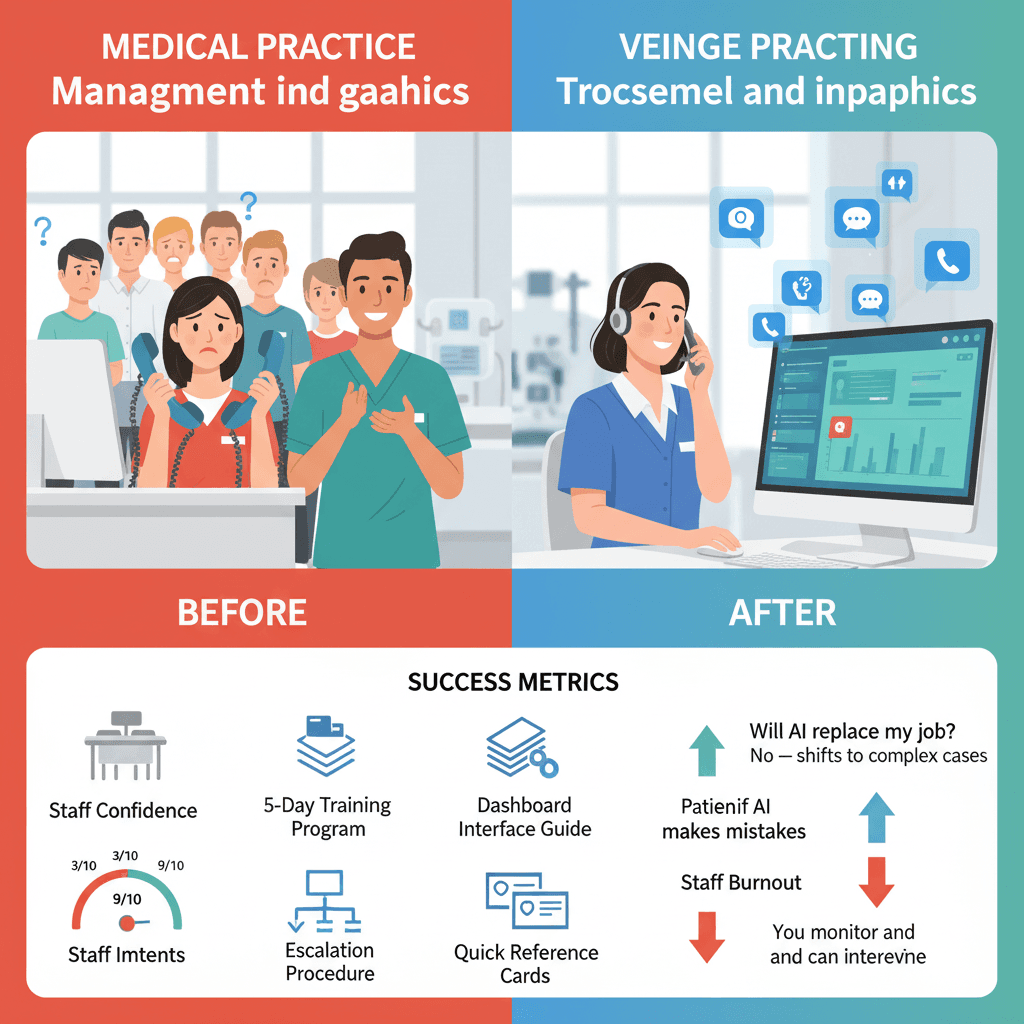
Featured Article
Implementation
The Critical Role of Training in Voice AI Adoption
Successfully integrating voice AI into your practice hinges on comprehensive staff training. Simply deploying the technology isn't enough. Your team needs to understand how to work with the AI, not against it. Proper training ensures a smooth transition, maximizes the benefits of voice AI, and minimizes potential disruptions to patient care.
Key Training Objectives for Your Team
This training program is designed to empower your team to effectively manage and leverage our voice AI solution. Upon completion, your staff will be able to:
Monitor the AI dashboard and proactively identify potential issues.
Efficiently handle calls escalated by the AI, leveraging available context.
Override or assist the AI when necessary, ensuring optimal patient experience.
Troubleshoot common scenarios and address frequently asked questions.
Provide valuable feedback to improve the AI's performance and accuracy.
Pre-Deployment Training: A Phased Approach
To ensure a gradual and effective learning process, we recommend a structured pre-deployment training week:
Week 1: Intensive Training
Day 1: Introduction to Voice AI (1 Hour): Understanding the capabilities of our voice AI solution and its anticipated impact on existing roles and workflows.
Day 2: Dashboard Overview (2 Hours): Hands-on training on real-time monitoring, reading call transcripts, and identifying situations requiring intervention.
Day 3: Escalation Procedures (2 Hours): Detailed review of AI transfer protocols, accessing relevant call context, and practicing professional patient handoff phrases.
Day 4-5: Hands-on Practice (4 Hours): Immersive simulation of real-world scenarios and role-playing escalation procedures to build confidence and proficiency.
Core Training Modules
The training program is structured around these essential modules:
Module 1: Understanding AI Capabilities: Differentiating between tasks handled automatically by the AI and those requiring human intervention. Clear understanding of AI boundaries.
Module 2: Monitoring Dashboard: Mastering the real-time call view, interpreting daily reports, and responding to critical alert triggers.
Module 3: Escalation Handling: Reviewing call transcripts, understanding the AI's attempted solutions, acknowledging information collected by the AI, and managing common escalation scenarios (billing inquiries, emergencies, complex scheduling).
Addressing Staff Concerns: Change Management Strategies
We understand that introducing new technology can raise questions and concerns. Here's how we address common anxieties:
"Will AI replace our jobs?": Absolutely not. The AI handles repetitive, routine calls, freeing you to focus on more complex patient needs and higher-value tasks.
"What if the AI makes mistakes?": You are the safety net! You actively monitor calls and can intervene instantly to correct errors and ensure patient satisfaction.
"Patients won't like interacting with AI": Studies show otherwise. Over 85% of patients appreciate the instant answers provided by AI. Furthermore, patient satisfaction scores are comparable, with 94% for human agents vs 88% after AI implementation.
Ongoing Training and Support
Training doesn't stop after the initial deployment. We provide continuous learning opportunities to ensure your team stays proficient and informed:
Weekly Team Meetings (30 minutes): Reviewing interesting and challenging call scenarios to foster best practices.
Monthly Performance Reviews: Identifying areas for improvement and providing personalized coaching.
Quarterly Refresher Training: Reinforcing core concepts and introducing new features or updates to the voice AI solution.
Valuable Training Resources
We offer a variety of resources to support your team's learning journey:
Quick Reference Guides: Easily accessible guides for common tasks and troubleshooting steps.
Video Tutorials: Step-by-step video demonstrations of key features and functionalities.
Dedicated Help Desk Support: Prompt and reliable assistance from our experienced support team.
Measuring Training Success
We track key metrics to evaluate the effectiveness of the training program:
Staff Confidence Scores (Pre/Post): Measuring confidence levels before and after training to assess knowledge gain.
Escalated Call Resolution Time: Optimizing the efficiency of handling escalated calls.
Patient Satisfaction on Transfers: Ensuring a seamless and positive patient experience during AI transfers.
Staff Feedback Submitted: Gathering valuable insights to continuously improve the training program and the voice AI solution.
About ConversAI Labs Team
ConversAI Labs specializes in AI voice agents for customer-facing businesses.