
Featured Article
Compliance
SOX Compliance and Voice AI in Banking: A Detailed Guide
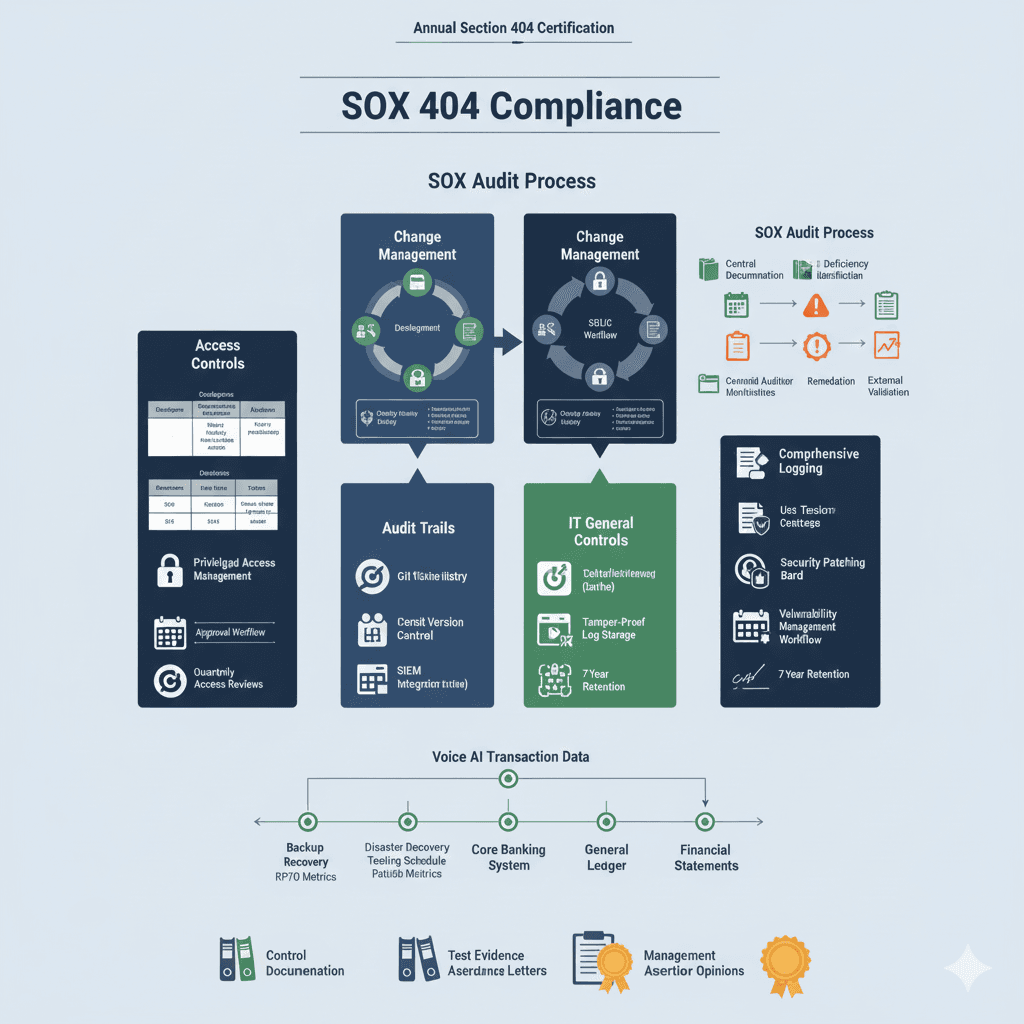
The Sarbanes-Oxley Act of 2002 (SOX) is a cornerstone of corporate governance, demanding that public companies, including banks, maintain stringent internal controls over financial reporting (ICFR). Section 404 of SOX specifically mandates management's assessment and external auditor attestation of these controls. With the increasing adoption of Voice AI in the banking sector, understanding the implications of SOX compliance becomes critical. Failure to comply can lead to publicly reported material weaknesses, impacting stock prices and inviting regulatory scrutiny. This guide provides a comprehensive overview of SOX compliance considerations specifically for Voice AI deployments within banking environments.
Understanding SOX's Applicability to Voice AI
Determining whether a Voice AI system falls under SOX's purview hinges on its impact on financial reporting. Consider the following:
Voice AI Systems In Scope:
Voice AI systems processing deposits, withdrawals, or transfers directly impacting the general ledger.
Systems supporting account balance calculations used for financial statements.
Platforms handling fee revenue generation and accounting for transactions.
Applications affecting the calculation of allowance for loan losses.
Voice AI Systems Out of Scope:
Marketing analytics applications.
Non-financial customer service implementations.
Voice systems with no direct or indirect impact on financial reporting data.
IT General Controls (ITGCs) for Voice AI
ITGCs form the foundation of SOX compliance. Here are key considerations for Voice AI systems:
Access Controls
Segregation of Duties: Prevent any single individual from handling development, testing, and deployment.
Role-Based Access Control (RBAC): Implement access based on the principle of least privilege.
Privileged Access Management (PAM): Secure and monitor administrator accounts.
Quarterly Access Reviews: Regularly certify that assigned permissions are appropriate.
Immediate Revocation: Revoke access promptly upon employee termination.
Multi-Factor Authentication (MFA): Enforce MFA for all system access points.
Change Management
Formal SDLC: Adhere to a well-documented Software Development Life Cycle.
Change Request Documentation: Thoroughly document business justification, risk assessments, and rollback plans.
Testing Evidence: Gather and retain unit test, integration test, and User Acceptance Testing (UAT) sign-offs.
Change Advisory Board (CAB) Approval: Require CAB approval for all production changes.
Emergency Change Procedures: Establish procedures for emergency changes, including post-implementation reviews.
Version Control: Use version control systems to maintain a complete audit trail of code changes.
Backup and Recovery
Daily Automated Backups: Implement daily backups with verification processes.
Off-Site Backup Storage: Store backups in a secure, off-site location.
Recovery Point Objective (RPO): Define and adhere to an RPO (e.g., maximum 24 hours).
Recovery Time Objective (RTO): Define and adhere to an RTO (e.g., maximum 8 hours).
Quarterly Backup Restoration Testing: Conduct regular testing of backup restoration processes.
Disaster Recovery Plan: Develop and annually test a comprehensive disaster recovery plan.
Security and Monitoring
Vulnerability Scanning and Patching: Regularly scan for vulnerabilities and apply patches promptly (critical patches within 30 days).
Comprehensive Audit Logging: Enable detailed audit logging of all financial-impacting activities.
Security Information and Event Management (SIEM): Implement a SIEM system for real-time monitoring and alerting.
Annual Penetration Testing: Conduct annual penetration testing to identify security weaknesses.
Incident Response Procedures: Establish well-defined incident response procedures.
Application Controls Specific to Voice AI
Beyond ITGCs, specific application controls are crucial for Voice AI systems handling financial transactions:
Input Controls
Transaction Amount Validation: Implement reasonability checks (e.g., deposits exceeding $1 million trigger review).
Authentication: Require robust authentication before financial transactions (e.g., voice biometrics combined with a knowledge factor).
Duplicate Transaction Detection: Identify and prevent duplicate transactions (e.g., same customer, amount, and timing).
Processing Controls
Automated Transaction Reconciliation: Automatically reconcile transactions recorded by the Voice AI system against those processed by the core banking system.
Exception Handling: Log and investigate failed transactions.
Interface Controls: Verify data integrity between the Voice AI system and core banking systems.
Output Controls
Transaction Confirmation: Provide transaction confirmations to customers.
Daily Reconciliation Reports: Generate daily reconciliation reports for review.
Error Log Review: Regularly review error logs for patterns and anomalies.
Audit Trail Requirements for SOX
A comprehensive and tamper-proof audit trail is essential for SOX compliance:
Capture who (user ID), what (action taken), when (timestamp), where (system component), why (business justification for sensitive actions), and how (method of access).
Maintain a complete transaction trail from customer voice request → AI processing → core banking execution → account update → general ledger impact.
Utilize tamper-proof log storage (append-only, encrypted, integrity verification).
Retain logs for a minimum of 7 years (matching financial record retention requirements).
Ensure logs are searchable and reportable to facilitate auditor requests.
SOX Documentation Requirements
Thorough documentation is the backbone of demonstrating SOX compliance. This includes:
Control Descriptions: Narratives explaining control operation, objectives, and frequency.
Process Flows: End-to-end diagrams illustrating Voice AI integration, visually highlighting control points.
Policies and Procedures: Documented standards for access, change management, security, and backups.
Test Evidence: Screenshots, reports, and approvals demonstrating control effectiveness.
Exception Management: Documented deviations, compensating controls, and remediation plans.
Management Assertions: Executive certifications confirming control effectiveness.
SOX Compliance Implementation Roadmap
A structured approach is critical to successful SOX implementation. Consider this roadmap:
Phase 1 (Scoping - 3-4 weeks): Identify in-scope Voice AI processes and IT systems, document business process narratives.
Phase 2 (Control Design - 4-6 weeks): Design key controls (access, change, security, monitoring), assign ownership and frequency, document descriptions and testing procedures, obtain management approval.
Phase 3 (Control Implementation - 8-12 weeks): Configure access controls with RBAC, implement change management workflow, deploy logging and monitoring, establish backup procedures, train control owners.
Phase 4 (Control Testing - 6-8 weeks continuous): Test controls quarterly/annually, document testing procedures and evidence, identify and remediate deficiencies.
Phase 5 (Management Assessment - 4 weeks annually): Evaluate control effectiveness, identify material weaknesses or significant deficiencies, document management's assessment of ICFR, certify to external auditors.
Phase 6 (External Audit - 6-10 weeks annually): Provide documentation, support control walkthroughs, furnish test evidence, respond to auditor inquiries, receive auditor attestation on ICFR.
Deficiency Classification
Understanding deficiency classifications is vital:
Control Deficiency: Control does not operate as designed.
Significant Deficiency: Important enough to merit attention by the audit committee, but not a material weakness.
Material Weakness: Reasonable possibility of material misstatement in financial statements not prevented or detected; must be publicly disclosed in the 10-K filing.
Common SOX Findings for Voice AI Systems
Be aware of common pitfalls:
Inadequate segregation of duties (developers with production access).
Insufficient change documentation (missing business approvals).
Gaps in access reviews (terminated users not removed promptly).
Incomplete audit trails (logs not capturing all required data).
Inadequate disaster recovery testing (not performed quarterly).
Weak password policies (8 characters vs. SOX best practice of 12+ characters).
SOX Readiness Checklist
Use this checklist to gauge your preparedness:
Access control matrix documented with RACI (Responsible, Accountable, Consulted, Informed).
Change management policy approved by CAB.
7-year log retention configured and verified.
Quarterly backup testing documented.
Annual penetration test completed with remediation.
ITGC documentation package complete.
Control testing schedule established.
Ongoing Compliance Maintenance
SOX compliance is not a one-time effort. Maintain ongoing compliance through:
Quarterly control testing execution.
Annual external audit coordination.
Continuous monitoring with automated controls.
Management quarterly certifications.
Annual policy reviews and updates.
Control owner training refreshers.
About ConversAI Labs Team
ConversAI Labs specializes in AI voice agents for customer-facing businesses.