
Featured Article
Implementation
The Imperative of Core Banking Integration for Voice AI
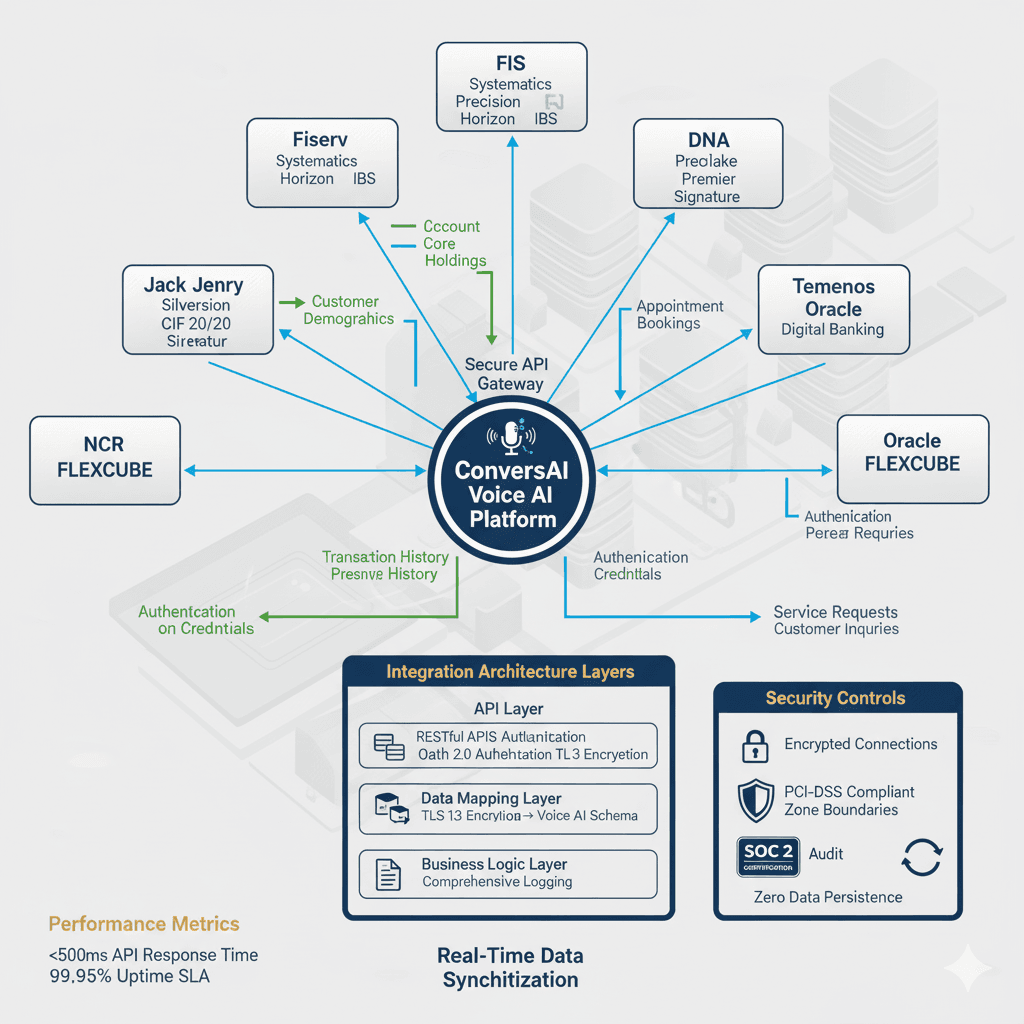
Voice AI's true potential in banking is unlocked through seamless integration with core banking systems. This connection enables real-time access to critical account data, facilitates secure transaction processing, enables robust customer verification, and empowers delivery of highly personalized banking services. While the complexity of integration varies depending on the core banking platform, the underlying principles and patterns remain consistent. A robust and well-planned integration is the bedrock of a successful voice AI deployment in the banking sector.
Major Core Banking Platforms and Integration Approaches
Several core banking platforms dominate the market. Here's a breakdown of common platforms and their integration characteristics:
FIS (27% US market share):
Products: Systematics (community banks), Horizon (regional banks), IBS (international banks), Profile (credit unions)
Integration: RESTful APIs via FIS Developer Portal, OAuth 2.0 authentication, JSON data format. Supports real-time balance inquiries, transaction posting, customer verification.
Typical Integration Time: 3-4 weeks
Fiserv (22% market share):
Products: DNA (digital-native architecture), Precision (community banks), Premier (credit unions), Signature (large regionals)
Integration: AppMarket APIs, SOAP and REST endpoints, extensive field mapping often required, batch and real-time modes available.
Integration Time: 4-6 weeks
Jack Henry (11% market share):
Products: Silverlake (community banks), CIF 20/20 (customer information), Core Director (core banking)
Integration: Banno Digital Platform APIs, strong digital banking APIs, WebSDK for custom integrations.
Integration Time: 3-5 weeks
Temenos (Global Leader):
Product: T24 Transact
Integration: TAFJ (Temenos Application Framework for Java) APIs, highly customizable, supports 150+ countries.
Integration Time: 6-8 weeks, due to customization.
Others: NCR Digital Banking, Oracle FLEXCUBE, SAP for Banking, Finastra Fusion.
Core Banking Integration Architecture: Key Components
A well-designed architecture is critical for a successful integration. Key components include:
API Gateway: Centralized entry point for all core banking API calls. Handles authentication (OAuth 2.0, API keys), rate limiting (prevents overload), SSL/TLS termination, and request routing to the appropriate backend service.
Data Mapping Layer: Transforms core banking data schemas to the voice AI schema. Addresses field differences across core platforms (e.g., mapping "CUST_F_NAME" to "customer.firstName"). Validates data types and formats and manages null/missing data gracefully.
Business Logic Layer: Encapsulates banking business rules (minimum balance checks before transfer, daily withdrawal limits, fraud scoring). Performs transaction validation before submission and manages multi-step workflows (e.g., transfer = check balance + verify accounts + post debit + post credit).
Error Handling: Provides graceful degradation (e.g., if a balance inquiry fails, apologize and transfer to an agent). Implements retry logic with exponential backoff, comprehensive error logging for troubleshooting, and provides customer-friendly error messages.
Audit and Compliance: Logs all API calls with timestamps, users, requests, and responses for SOX compliance. Implements PCI-DSS logging for payment transactions and adheres to data retention requirements (e.g., 7 years).
Step-by-Step Integration Process: A Sample Timeline
This timeline provides a general framework. Adjust based on the specific core banking platform and project requirements.
Week 1 (Discovery and Access):
Day 1-2: Obtain API credentials from the core banking vendor (requires an existing customer relationship). Configure the OAuth application and set up a sandbox/test environment.
Day 3-5: Review API documentation, identifying endpoints needed (customer lookup, balance inquiry, transaction history, fund transfer, bill payment). Understand the authentication flow and test basic connectivity.
Week 2 (Data Mapping):
Day 6-8: Document the core banking data schema for customers, accounts, and transactions. Map fields to voice AI requirements and identify custom fields specific to the bank.
Day 9-10: Build the data transformation layer. Create a mapping configuration (often in JSON format) and test data retrieval and mapping accuracy.
Week 3 (Integration Development):
Day 11-13: Develop API integration modules for each use case (e.g., balance inquiry → GET /accounts/{id}/balance, fund transfer → POST /transactions/transfer). Implement error handling and retries, and add logging and monitoring.
Day 14-15: Build the business logic layer, enforcing banking rules. Configure fraud detection integration and develop transaction confirmation workflows.
Week 4 (Testing):
Day 16-17: Unit testing of each API integration with mock data. Integration testing with the sandbox environment. Test error scenarios (invalid account, insufficient funds, timeout).
Day 18-20: User acceptance testing (UAT) with the bank operations team. Process real test transactions in the sandbox environment. Conduct performance testing (100+ concurrent API calls) and security testing (penetration test of APIs).
Week 5-6 (Production Deployment):
Day 21-25: Configure production API credentials. Deploy to the production environment with monitoring. Implement parallel run (voice AI and existing systems processing simultaneously for validation).
Day 26-30: Gradual rollout, starting with 10% of calls. Monitor for errors and performance issues. Aim to achieve 90%+ volume.
Critical Integration Considerations
Real-time vs. Batch: Balance inquiries *must* be real-time. Transaction posting can be near-real-time (1-2 second delay acceptable). Use batch processes for non-urgent data (monthly statement retrieval).
API Rate Limiting: Understand core banking API limits (often 100-500 requests/minute). Implement client-side rate limiting and queuing. Negotiate higher limits if needed for anticipated call volume.
Data Freshness: Understand how frequently customer demographics are updated (daily batch vs. real-time). Account balance accuracy (some cores show pending transactions differently). Implement a caching strategy (cache static data like account types, *never* cache balances).
Security: Encrypt all API traffic with TLS 1.3. Use service accounts with minimal permissions. Rotate API keys quarterly. Implement IP whitelisting if required.
Disaster Recovery: Handle core banking downtime gracefully (transfer to an agent with an apology). Implement the circuit breaker pattern (stop calling a failing API). Have fallback processes documented.
Use Case API Mapping Examples
These examples illustrate how voice AI commands map to core banking API calls.
Balance Inquiry:
Voice AI: "What's my checking balance?"
API Call: `GET /accounts/{accountId}/balance`
Response: `{accountId, accountType, currentBalance, availableBalance, currency}`
Voice AI: "Your checking account ending in 4392 has an available balance of $5,847.23."
Fund Transfer:
Voice AI: "Transfer $500 from savings to checking."
API Calls:
(a) `GET /accounts?customerId={id}` to retrieve the account list.
(b) `POST /transactions/transfer` with `{fromAccountId, toAccountId, amount, currency}`
Response: `{transactionId, status, confirmationNumber}`
Voice AI: "I've transferred $500 from your savings to checking. Your confirmation number is T7829X4P."
Transaction History:
Voice AI: "What are my recent transactions?"
API Call: `GET /accounts/{accountId}/transactions?startDate={date}&count=10`
Response: array of `{transactionId, date, description, amount, type, balance}`
Voice AI: "Your most recent transactions are: July 15th, Amazon for $42.18; July 14th, Shell Gas for $65.00..."
Common Integration Challenges and Solutions
Challenge: Core banking APIs are slow (3-5 second response).
Solution: Implement asynchronous processing, inform the customer "checking that for you," and optimize queries.
Challenge: Custom fields used by the bank are not in the standard API.
Solution: Request custom API endpoints, use extension fields, and document workarounds.
Challenge: Different account numbering between the core and the display.
Solution: Map internal account IDs to customer-facing masked numbers and maintain a lookup table.
Challenge: API authentication expires during a call.
Solution: Implement token refresh logic, handle 401 errors gracefully, and maintain session state.
Production Readiness Checklist
Before going live, ensure the following are in place:
API credentials secured in a vault (not hardcoded).
Error handling tested for all failure scenarios.
Rate limiting configured below core limits.
Comprehensive logging enabled.
Monitoring dashboards created.
Disaster recovery procedures documented.
Security review completed (penetration test).
Performance tested at peak volume (2× expected load).
UAT signoff obtained from operations.
Rollback plan prepared.
Ongoing Maintenance Requirements
Monthly API key rotation.
Quarterly security reviews.
Continuous monitoring of API performance.
Regular testing of disaster recovery procedures.
Annual core banking upgrade coordination (test voice AI compatibility).
About ConversAI Labs Team
ConversAI Labs specializes in AI voice agents for customer-facing businesses.