
Featured Article
Technology
The Authentication Challenge in Modern Banking
Traditional authentication methods in banking are increasingly vulnerable. Knowledge-based authentication, such as passwords and security questions, has proven inadequate. Massive data breaches expose billions of credentials, leaving accounts ripe for takeover. SMS one-time codes, while once considered secure, are susceptible to SIM swapping attacks, rendering them unreliable. The banking industry needs a more secure and frictionless method for verifying customer identity.
Voice Biometric Authentication: A Powerful Solution
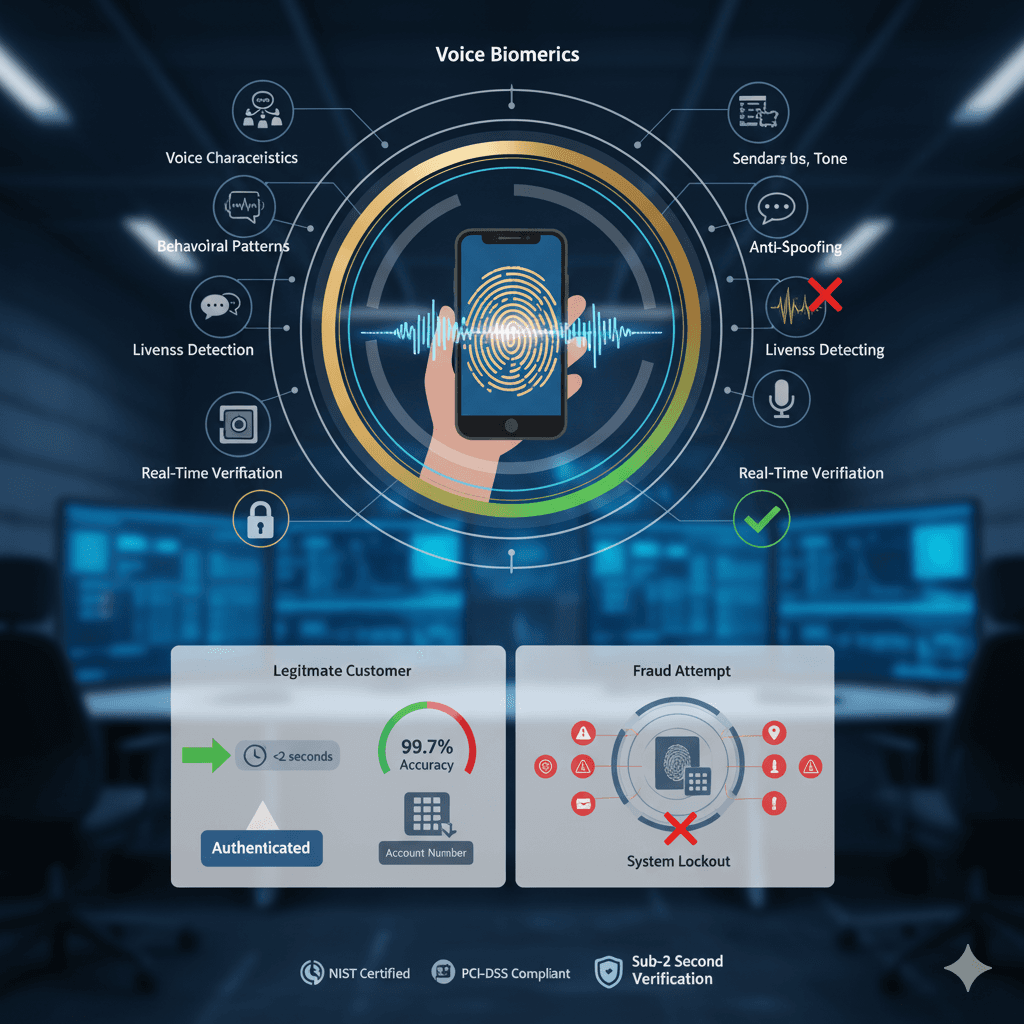
Voice biometrics offers a robust and user-friendly solution to the authentication challenge. It leverages the unique characteristics of an individual's voice to verify their identity. This technology goes beyond simple voice recognition; it analyzes over 100 unique vocal characteristics.
How Voice Biometrics Works
Unique Voiceprint Creation: Voice biometrics captures distinctive vocal features, including pitch, tone, cadence, pronunciation, and nasal resonance, to create a unique voiceprint.
Enrollment Process: Customers enroll by speaking 3-5 casual phrases during a normal conversation. Passive enrollment eliminates the need for specific phrases, making the process seamless.
Verification Process: During verification, a real-time comparison is made between the user's current voice and their stored voiceprint template. This probabilistic matching achieves a high level of accuracy.
Security Features: Protecting Customer Data
Security is paramount in voice biometric authentication. The technology incorporates several layers of protection:
Encrypted and Tokenized Voiceprints: Voiceprint templates are encrypted and tokenized, ensuring they cannot be reverse-engineered to recreate a user's voice.
PCI-DSS Compliant Storage: Voice data is stored in PCI-DSS compliant environments, adhering to the highest standards of data security.
Multi-Factor Authentication: Combining Knowledge and Biometrics
For enhanced security, voice biometrics can be integrated into a multi-factor authentication system. An example is requesting a customer to verify their account number while simultaneously analyzing their voice. This layered approach combines knowledge-based authentication with the security of biometrics.
Anti-Spoofing and Liveness Detection
Sophisticated anti-spoofing and liveness detection mechanisms protect against fraudulent attempts to impersonate a user:
Recording Playback Detection: Frequency analysis identifies recording artifacts, indicating a playback attempt.
Text-to-Speech (TTS) Synthesis Detection: Unnatural prosody patterns are detected in TTS generated audio.
Voice Conversion Attack Detection: Biometric inconsistencies are identified in converted voices.
Deepfake Audio Detection: AI-generated voices are detected through statistical anomalies.
Real-World Performance: Proven Results
Voice biometrics has demonstrated impressive performance in real-world banking environments:
High Accuracy: 99.7% true positive rate (legitimate customers verified) and 0.1% false positive rate (fraudsters blocked).
Fast Verification: Average verification time of less than 2 seconds.
Customer Acceptance: 98% customer acceptance rate, preferring voice authentication to passwords.
Fraud Reduction: 85% reduction in account takeover fraud.
Banking Use Cases: Enhancing Security Across Channels
Voice biometrics can be applied across various banking channels to enhance security and improve the customer experience:
IVR Authentication: Replacing account numbers and PINs in interactive voice response (IVR) systems.
Call Center Verification: Authenticating callers before discussing account details.
High-Risk Transaction Confirmation: Confirming wire transfers and other high-value transactions.
Account Recovery: Replacing security questions with voice-based verification.
Mobile Banking App Voice Login: Providing a secure and convenient login option.
Deployment Architecture: Ensuring Scalability and Security
A robust deployment architecture is essential for successful voice biometric implementation:
Edge Processing: Real-time voice analysis performed at the edge for faster response times.
Encrypted Voiceprint Transmission: Secure transmission of voiceprints to prevent interception.
Secure Cloud Storage: Secure cloud storage with geographic redundancy for data protection and availability.
API Integration: Seamless API integration with core banking and fraud detection systems.
Audit Logging: Comprehensive audit logging for compliance and security monitoring.
Regulatory Compliance: Meeting Industry Standards
Voice biometric solutions must adhere to relevant regulatory guidelines:
FFIEC Authentication Guidance: Meets FFIEC guidelines for multi-factor authentication.
PCI-DSS Compliance: Compliant with PCI-DSS standards for payment processing.
GLBA Requirements: Supports GLBA requirements for customer data protection.
SOC 2 Type II Certification: Infrastructure is SOC 2 Type II certified.
Implementation Considerations: Best Practices for Success
Successful voice biometric implementation requires careful planning:
Customer Enrollment Strategy: Decide between passive (during calls) and active enrollment methods.
Fraud Threshold Calibration: Balance security with user experience by calibrating fraud thresholds.
Fallback Authentication: Provide alternative authentication methods for users with voice issues.
Customer Privacy Controls and Consent: Implement robust privacy controls and obtain customer consent.
Performance Monitoring Dashboards: Monitor performance metrics to optimize the system.
Return on Investment (ROI): Beyond Security
The benefits of voice biometrics extend beyond security:
Cost Savings: $12-18 per call saved in authentication time, with a 40-60 second reduction in call duration.
Improved Customer Satisfaction: 94% customer satisfaction rate compared to 78% for password authentication.
Competitive Differentiation: Offering a more secure and convenient authentication experience can provide a competitive edge.
About ConversAI Labs Team
ConversAI Labs specializes in AI voice agents for customer-facing businesses.