
Featured Article
Technology
Integrating Voice AI with Retail POS Systems: A Technical Guide
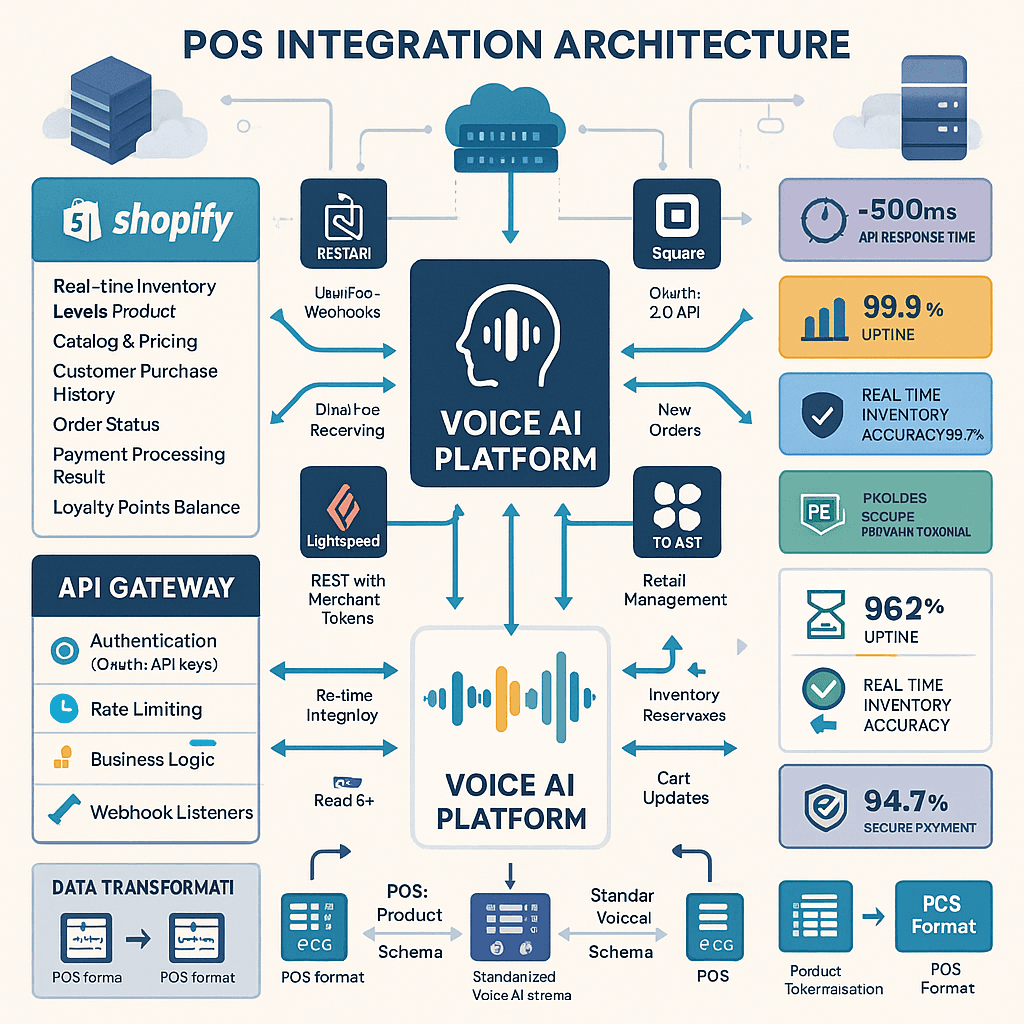
In today's competitive retail landscape, integrating Voice AI with Point of Sale (POS) systems is no longer a luxury, but a necessity. This integration unlocks real-time inventory visibility, streamlined order processing, secure payment handling, and seamless access to customer data. By connecting Voice AI with POS, retailers can deliver a truly omnichannel experience, offering customers a consistent and convenient shopping journey across all touchpoints. While the complexity of this integration varies depending on the specific platforms involved, the underlying principles and architectural patterns remain consistent.
Why Integrate Voice AI with Your POS System?
Real-time Inventory Visibility: Know exactly what's in stock, where, and when.
Streamlined Order Processing: Create and manage orders seamlessly through voice commands.
Secure Payment Handling: Process payments securely and efficiently using integrated payment gateways.
Unified Customer Data: Access customer profiles, purchase history, and preferences to personalize the shopping experience.
Enhanced Omnichannel Experience: Provide a consistent and convenient shopping journey across all channels.
Major POS Platforms and Integration Approaches
Here's a breakdown of popular POS platforms and their corresponding integration strategies:
Shopify (E-commerce Leader)
Market Share: ~28% of the online retail market.
Integration: REST Admin API and Storefront API, webhook subscriptions, OAuth 2.0 authentication.
Capabilities: Product catalog, real-time inventory, order management, customer profiles, Shopify Payments integration.
Typical Integration Time: 2-3 weeks.
Square (SMB Focused)
Market Share: ~18%.
Integration: Square Connect API (REST), OAuth, webhook events.
Capabilities: Catalog management, real-time inventory, payment processing, customer directory, loyalty programs.
Integration Time: 2-4 weeks.
Lightspeed (Specialty Retail)
Focus: Retail and restaurant POS, strong in specialty retail.
Integration: Lightspeed Retail API (REST or GraphQL), OAuth 2.0.
Capabilities: Multi-location inventory, customer accounts, purchase history, layaway management, e-commerce integration.
Integration Time: 3-4 weeks.
Clover (Versatile Platform)
Focus: Versatile merchant platform.
Integration: Clover REST API, merchant tokens, app permissions model.
Capabilities: Inventory management, order creation, payment acceptance, customer engagement.
Integration Time: 2-3 weeks.
Other Notable POS Systems
Consider these platforms as well:
Toast (Restaurants)
Vend (Retail Management)
Revel (iPad POS)
NCR Counterpoint
Integration Architecture Components
A robust Voice AI and POS integration requires a well-defined architecture. Key components include:
API Gateway
The central connection point for all POS API calls. Responsibilities include authentication (OAuth 2.0, API keys, merchant tokens), rate limiting (100-1000 req/min per merchant), SSL/TLS encryption, and request/response logging.
Data Synchronization Engine
Ensures data consistency. Employs real-time sync via webhooks for critical data (inventory, order status, payments) and periodic sync (hourly/nightly) for less dynamic data. Includes conflict resolution and sync status monitoring.
Schema Mapping Layer
Transforms POS-specific data models into a unified Voice AI schema. Handles field differences (e.g., mapping "variant_id" to "product_sku"), validates data types, and manages null values.
Business Logic Layer
Implements retail-specific logic, such as inventory reservation, multi-location inventory checking, price/tax calculation, and order validation.
Payment Processing Integration
Handles secure payment tokenization for voice orders. Requires PCI-DSS compliance, encrypted transmission, and robust payment confirmation/refund flows.
Error Handling and Resilience
Ensures application stability. Implements graceful degradation, retry logic with exponential backoff, circuit breaker patterns, and comprehensive error logging/alerting.
Step-by-Step Integration Process (Estimated 4-5 Weeks)
This outlines a general timeline; actual duration may vary.
Week 1: Setup and Access
Days 1-2: Obtain POS API credentials, configure OAuth applications, set up sandbox environment.
Days 3-5: Review API documentation, test basic connectivity, understand rate limits.
Week 2: Data Integration
Days 6-9: Build product catalog sync, implement inventory tracking, create customer data integration.
Day 10: Test data accuracy and sync performance.
Week 3: Order Processing
Days 11-14: Develop order creation flow, integrate payment processing, build order status tracking, implement return/exchange processing.
Day 15: End-to-end order testing.
Week 4: Testing and Optimization
Days 16-18: Integration, error, performance, and security testing.
Days 19-21: User acceptance testing, API optimization, prepare for deployment.
Week 5: Production Launch
Days 22-25: Configure production credentials, deploy with monitoring, parallel testing, gradual rollout.
Days 26-30: Monitor for issues, full production rollout, documentation for support.
Critical Integration Considerations
Pay close attention to these key areas:
Inventory Accuracy
Sync frequency (real-time vs. batch), inventory reservation, multi-location logic, safety stock buffers are crucial.
Product Catalog Management
Handle variants correctly, sync product images, capture product attributes for voice search, and map categories.
Real-time vs. Batch Updates
Inventory and pricing must be real-time. Catalog updates and purchase history can often be batched.
Payment Security
Tokenize data immediately, comply with PCI-DSS, encrypt all transmissions, and audit API calls.
Error Messages
Translate POS error codes into user-friendly messages and provide alternatives when possible.
Performance Optimization
Cache static data, batch API calls, implement connection pooling, and monitor API response times with SLA alerts.
Retail-Specific Use Cases with API Flows
Here are example interactions and the API calls behind them:
Product Availability Check
Customer: "Do you have the Nike Air Max in size 10?"
Voice AI:
GET /products?query="Nike Air Max"GET /inventory?product_id=X&variant=size-10
Response: "Yes, we have 3 pairs at the downtown location and 5 at the mall store."
Voice Order Placement
Customer: "I'd like to order that in size 10 for store pickup"
Voice AI:
POST /orders {product_id, variant, quantity, customer_id, fulfillment="pickup", location="downtown"}POST /payments {token, amount}PUT /orders/123/confirm
Response: "Your order is confirmed! Pickup at downtown store in 2 hours. Confirmation #7829"
Order Status Check
Customer: "Where's my order?"
Voice AI:
GET /customers/{id}/ordersGET /orders/123/status
Response: "Your Nike Air Max order shipped yesterday via FedEx, tracking #123456789, estimated delivery tomorrow"
Return Processing
Customer: "I need to return the shoes"
Voice AI:
GET /orders/123POST /returns {order_id, reason, refund_method}
Response: "Return initiated. Bring the shoes to any store location within 30 days for full refund to your original payment method."
Common Integration Challenges and Solutions
Anticipate and plan for these common pitfalls:
Challenge: POS API Rate Limits
Solution: Implement request queuing, caching, batch operations, negotiate higher limits.
Challenge: Inventory Sync Delays
Solution: Webhook-based real-time updates, safety stock buffer, "availability not guaranteed" disclaimer.
Challenge: Complex Product Variants
Solution: Structured variant mapping, guided selection flow.
Challenge: Multiple Locations
Solution: Location-aware search, "check all locations" option, transfer between stores.
Challenge: POS Downtime
Solution: Fallback to phone transfer, cached product info, uptime monitoring with auto-failover.
Production Readiness Checklist
Ensure your integration is ready for prime time:
POS API credentials secured in secrets vault.
Authentication tokens with auto-refresh.
Inventory sync operational with < 5 min latency.
Payment integration PCI-DSS certified and tested.
Error handling tested for all failure modes.
Monitoring dashboards showing API health.
Webhook listeners with backup queue if POS down.
Data mapping validated for all product attributes.
Order lifecycle tested end-to-end.
Security review completed.
Load testing at 2× expected peak traffic.
Rollback plan documented and tested.
Support team trained on troubleshooting integration issues.
Ongoing Maintenance
Continuous monitoring and proactive maintenance are essential for a stable integration:
Monitor API performance daily (response times, error rates, uptime).
Monthly API version upgrade checks (POS platforms deprecate old API versions).
Quarterly security reviews (rotate credentials, audit access).
Continuous sync validation (inventory accuracy spot checks).
Customer feedback monitoring (are orders processing correctly?).
Holiday season capacity planning (scale infrastructure for Black Friday/Cyber Monday traffic spikes).
About ConversAI Labs Team
ConversAI Labs specializes in AI voice agents for customer-facing businesses.