
Featured Article
Industry Solutions
PCI-DSS Compliance Guide for Voice AI in Banking and Payment Processing
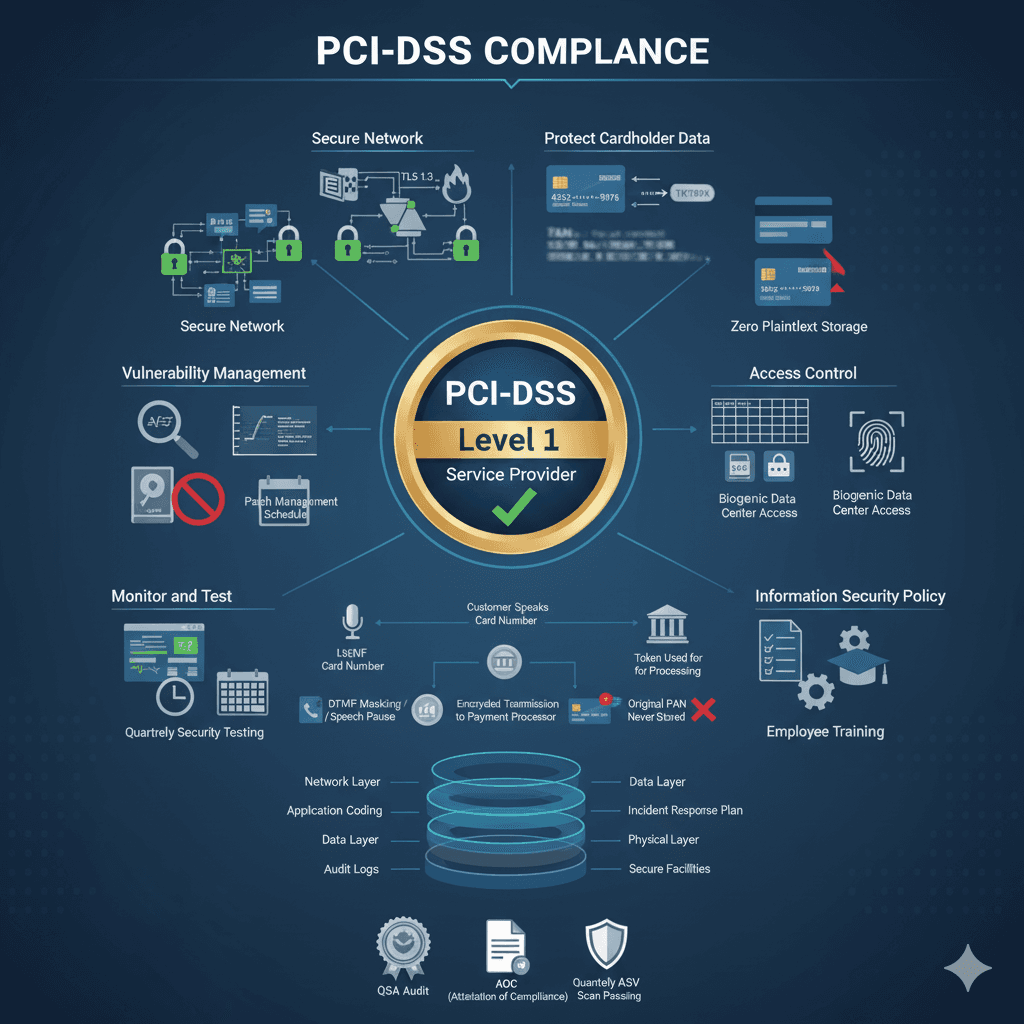
The Payment Card Industry Data Security Standard (PCI-DSS) is an imperative for any organization that stores, processes, or transmits cardholder data. Failure to comply can result in hefty fines ranging from $5,000 to $100,000 per month, loss of payment processing privileges, liability for data breaches, and severe reputational damage. For banking and payment processing institutions leveraging Voice AI, ensuring PCI-DSS compliance is paramount, particularly as these systems often handle sensitive cardholder information.
When Voice AI handles card payments, it is typically considered a Level 1 Service Provider under PCI-DSS, which means adhering to the strictest compliance tier.
PCI-DSS Scope for Voice AI Systems
Understanding the scope of PCI-DSS within Voice AI implementations is crucial. Let’s break down what's typically in and out of scope:
In Scope:
IVR systems processing payments: Interactive Voice Response systems that directly take card payments.
Voice platforms capturing card numbers: Any platform where customers verbally provide their card details.
Call recordings with cardholder data: Recordings that inadvertently capture cardholder information.
APIs connecting to payment processors: Interfaces that transmit cardholder data to payment gateways.
Databases storing tokens: Repositories holding tokenized cardholder data.
Network infrastructure transmitting payment data: All network components involved in the transmission of cardholder data.
Out of Scope:
Systems handling only non-payment calls: Voice AI systems used exclusively for inquiries unrelated to payments.
Properly de-scoped network segments: Network areas isolated from systems processing cardholder data.
Applications processing only tokens: Applications that handle only tokens and never interact with raw cardholder data (PANs).
The 12 PCI-DSS Requirements Applied to Voice AI
The core of PCI-DSS consists of 12 requirements that must be meticulously addressed. Here's how they apply to Voice AI:
Requirement 1: Install and Maintain a Firewall Configuration to Protect Cardholder Data
Implement network segmentation to isolate voice payment systems.
Establish strict firewall rules restricting access to cardholder data environments.
Ensure secure VoIP communications using SIP over TLS.
Requirement 2: Do Not Use Vendor-Supplied Defaults for System Passwords and Other Security Parameters
Disable default passwords on all systems.
Remove or disable unnecessary services.
Implement secure configuration standards specifically for voice platforms.
Requirement 3: Protect Stored Cardholder Data
CRITICAL: Absolutely no storage of full PAN (Primary Account Number) is permitted after authorization.
Implement immediate tokenization. For example, if a customer speaks "4532-1234-5678-9876," the system should capture the audio, instantly tokenize it to something like "TK892X4P," and *only* store the token.
Utilize AES-256 encryption for any temporarily captured data.
Implement secure deletion protocols to ensure complete data removal.
Requirement 4: Encrypt Transmission of Cardholder Data Across Open, Public Networks
Use TLS 1.3 or higher for all cardholder data transmissions.
Employ encrypted SIP trunks for VoIP communications.
Establish VPN tunnels when communicating with payment processors.
Requirement 5: Protect All Systems Against Malware and Regularly Update Antivirus Software or Programs
Implement endpoint protection on all voice servers.
Conduct regular malware scans.
Ensure automatic updates for all security software.
Requirement 6: Develop and Maintain Secure Systems and Applications
Adhere to secure coding practices for all voice applications.
Apply regular vulnerability patches within 30 days of release.
Conduct annual penetration testing of voice AI applications.
Perform thorough code reviews.
Requirement 7: Restrict Access to Cardholder Data by Business Need-to-Know
Implement role-based access control.
Assign unique IDs to all users.
Prohibit shared administrative accounts.
Enforce Multi-Factor Authentication (MFA) for remote access.
Requirement 8: Identify and Authenticate Access to System Components
Enforce strong passwords (12+ characters minimum).
Mandate MFA for access to the cardholder data environment.
Consider biometric authentication for data center access.
Requirement 9: Restrict Physical Access to Cardholder Data
Implement robust data center access controls with badge readers and cameras.
Maintain visitor logs.
Establish and enforce media destruction procedures for disposing of physical media containing cardholder data.
Requirement 10: Track and Monitor All Access to Network Resources and Cardholder Data
Implement comprehensive audit logging of all access to cardholder data.
Utilize a Security Information and Event Management (SIEM) system with real-time alerts.
Retain logs for at least one year.
Conduct daily log reviews.
Requirement 11: Regularly Test Security Systems and Processes
Conduct quarterly external vulnerability scans by an Approved Scanning Vendor (ASV).
Perform annual penetration testing by a Qualified Security Assessor (QSA) or a qualified internal team.
Deploy intrusion detection systems (IDS).
Implement file integrity monitoring (FIM).
Requirement 12: Maintain a Policy That Addresses Information Security for All Personnel
Document a comprehensive information security policy covering all PCI-DSS requirements.
Conduct annual risk assessments.
Develop and maintain an incident response plan.
Provide regular employee security awareness training.
Voice-Specific PCI Compliance Challenges and Solutions
Voice AI presents unique challenges to PCI-DSS compliance. Here are some common issues and their corresponding solutions:
Challenge: Customers Speaking Card Numbers
The primary challenge is that customers often verbally provide their card numbers, creating audio cardholder data.
Solutions:
DTMF Masking: Guide customers to enter their card details using the telephone keypad (DTMF tones) instead of speaking them.
Pause-and-Resume: The AI system pauses the recording during PAN capture, resuming only after the card number entry is complete.
Immediate Tokenization: As explained above, instantly convert the captured card number into a token.
Redaction: Remove the spoken card number from any call transcripts or recordings.
Challenge: Call Recordings for Quality Assurance
Call recordings used for quality assurance purposes can inadvertently capture payment information.
Solutions:
Automatic PAN Detection and Removal: Employ software that automatically detects and removes PANs from recordings.
Separate Payment Call Handling: Route payment-related calls through a system that does not record calls.
Encryption of Recordings: Encrypt any recordings that may contain cardholder data.
Strict Retention Limits: Implement strict retention policies for call recordings, deleting them as soon as they are no longer needed.
Challenge: Voice Biometrics Processing
Voice biometrics, while enhancing security, also involves processing sensitive biometric data.
Solutions:
Voiceprint Tokenization: Tokenize the voiceprint itself, creating an irreversibly encrypted biometric template.
Separate Biometric Processing: Keep biometric processing separate from payment processing to minimize PCI scope.
Explicit Customer Consent: Obtain explicit customer consent before collecting and processing voice biometric data.
Compliance Validation Process
Validating PCI-DSS compliance is a multi-faceted process:
Self-Assessment Questionnaire (SAQ D for service providers): Complete a detailed questionnaire (SAQ D for service providers) with 329 questions covering all 12 PCI-DSS requirements.
Quarterly Vulnerability Scans: Undergo external vulnerability scans by an Approved Scanning Vendor (ASV) and provide a passing report.
Annual Penetration Testing: Conduct annual penetration testing by a Qualified Security Assessor (QSA) or a qualified internal team, covering both application and network layers.
Attestation of Compliance (AOC): Submit an Attestation of Compliance (AOC), which is an executive certification of compliance signed by a company officer.
QSA Audit for Level 1: Undergo an annual on-site assessment by a certified QSA auditor. This involves extensive evidence collection and validation, culminating in a comprehensive report.
Implementation Roadmap for Voice AI PCI Compliance
A structured implementation roadmap ensures a smooth path to PCI-DSS compliance:
Phase 1 (Scoping - 2 weeks):
Identify all systems that interact with cardholder data.
Segment the network to minimize the scope of PCI compliance.
Document data flows to understand how cardholder data moves through the system.
Phase 2 (Gap Assessment - 3 weeks):
Compare the current security posture against the 12 PCI-DSS requirements.
Identify areas of non-compliance.
Prioritize remediation efforts based on risk.
Phase 3 (Remediation - 8-12 weeks):
Implement tokenization for PAN handling.
Configure encryption and access controls.
Deploy monitoring and logging systems.
Update policies and procedures.
Phase 4 (Validation - 4 weeks):
Conduct an internal audit of implemented controls.
Perform penetration testing.
Run vulnerability scans.
Review documentation for completeness and accuracy.
Phase 5 (Certification - 2-4 weeks):
Undergo a QSA audit for Level 1 compliance.
Complete the SAQ.
Submit the AOC to the relevant card brands.
Establish a process for ongoing quarterly validation.
Cost Considerations
While PCI-DSS compliance requires investment, the cost of non-compliance is significantly higher:
QSA audit: $15,000 - $35,000 annually
ASV scanning: $2,000 - $6,000 quarterly
Remediation costs: Varies widely based on the complexity of the environment and the number of identified gaps.
The fines and breach costs associated with non-compliance can far exceed these investments. According to the Ponemon Institute, the average cost of a data breach is $3.9 million.
Common Pitfalls to Avoid
Be aware of these common pitfalls that can lead to PCI-DSS non-compliance:
Storing full PANs, even temporarily (a direct violation of Requirement 3).
Using weak encryption algorithms (must be AES-256 or equivalent).
Inadequate logging practices (must capture all access to cardholder data).
Missing documentation for compensating controls.
Scope creep resulting from poor network segmentation.
Maintenance Checklist
Ongoing maintenance is crucial for sustaining PCI-DSS compliance:
Conduct quarterly vulnerability scans.
Perform annual penetration testing.
Monitor logs daily.
Review access controls monthly.
Review policies quarterly.
Update the risk assessment annually.
Provide continuous employee training.
Apply patches promptly (within the required 30-day timeframe).
About ConversAI Labs Team
ConversAI Labs specializes in AI voice agents for customer-facing businesses.