
Featured Article
Technology
The Critical Need for Medical-Grade Speech Recognition
In the fast-paced and high-stakes world of healthcare, accurate communication is paramount. While generic speech recognition software has become commonplace, its limitations become glaringly apparent when applied to medical settings. These systems often struggle with the nuances of medical terminology, leading to errors that can have serious consequences.
Why General Speech Recognition Fails in Healthcare
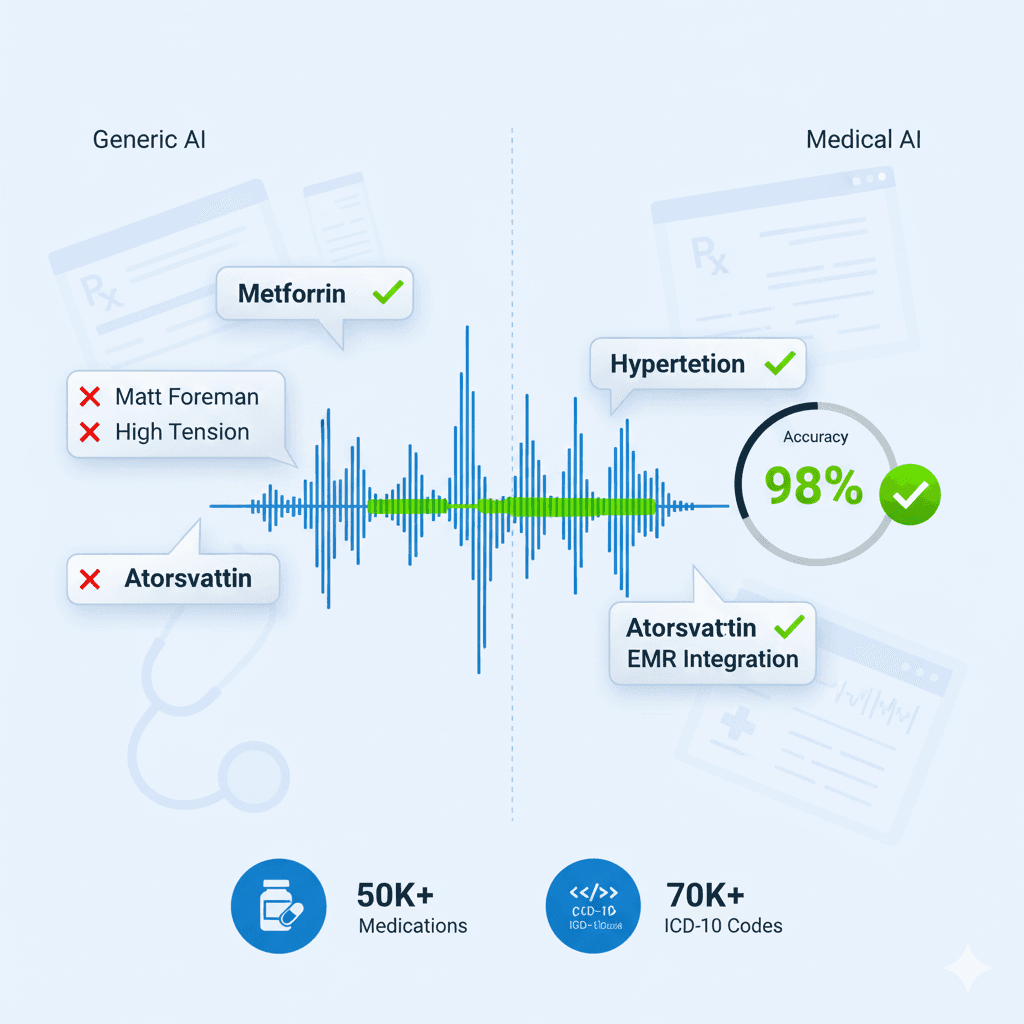
The complexity of medical language presents a significant challenge. Consider the potential for confusion between terms like "hypertension" and "hypotension," or the disastrous consequences of mishearing medication names. Generic systems lack the specialized knowledge to differentiate these critical distinctions. Imagine the implications of a patient being prescribed the wrong dosage due to a transcription error stemming from inaccurate speech recognition.
Key Features of Medical Speech Recognition
Medical-grade speech recognition is designed to overcome the shortcomings of generic systems. These solutions incorporate specialized features tailored to the specific demands of healthcare.
Extensive Medical Vocabulary: Includes over 50,000 medication names and 70,000 ICD-10 codes.
Accent and Dialect Handling: Optimized for the diverse range of accents and dialects found across the US population.
Advanced Noise Filtering: Effectively filters out background noise common in busy medical offices.
Real-time Transcription: Provides immediate transcription for seamless integration with Electronic Medical Records (EMRs).
HIPAA Compliance: Ensures patient data is processed securely and in compliance with HIPAA regulations through encrypted data transmission and storage.
Unparalleled Accuracy: Benchmarked on Real Patient Calls
Our medical-grade speech recognition has been rigorously tested using data from over 10,000 real patient calls. The results speak for themselves:
Medications (e.g., Metformin, Lisinopril, Atorvastatin): 98.2% accuracy
Symptoms and Conditions: 97.8% accuracy
Scheduling Language: 99.1% accuracy
Non-Native Speakers: 96.5% accuracy
These benchmarks demonstrate the superior accuracy and reliability of our medical-grade solution compared to generic alternatives.
Practical Use Cases in Healthcare
Medical speech recognition can be applied across a wide range of healthcare workflows, improving efficiency and reducing errors.
Appointment Scheduling: Accurately captures patient requests and provider names.
Prescription Refills: Precisely records medication names, dosages, and instructions.
Symptom Triage: Efficiently gathers patient information for initial assessments.
Insurance Verification: Automates the verification process by extracting relevant data.
Seamless EMR Integration
Our speech recognition technology seamlessly integrates with leading EMR systems, including Epic, Cerner, and Athenahealth. This integration allows for the automatic population of patient records, saving valuable time and reducing the risk of manual data entry errors.
Enhancing Efficiency and Reducing Errors
By leveraging medical-grade speech recognition, healthcare organizations can significantly improve operational efficiency, enhance patient care, and minimize the risk of costly errors. Accurate transcription translates directly into better documentation, improved communication, and ultimately, better patient outcomes.
Prioritizing Accuracy for Better Patient Care
In healthcare, accuracy is not just a desirable feature; it is a critical requirement. Our medical-grade speech recognition technology is designed to meet the rigorous demands of the industry, providing healthcare professionals with a reliable and accurate tool to improve patient care and streamline workflows.
```
About ConversAI Labs Team
ConversAI Labs specializes in AI voice agents for customer-facing businesses.