
Featured Article
Industry Solutions
Measuring Voice AI Performance: The Key to Success in Medical Practices
Voice AI is revolutionizing patient communication and operational efficiency in medical practices. However, realizing its full potential requires diligently tracking performance using the right Key Performance Indicators (KPIs). By measuring the metrics that truly matter, practice administrators can justify their investment, identify areas for optimization, and ultimately improve patient care and practice profitability.
Essential KPIs for Voice AI in Healthcare
These KPIs provide a comprehensive view of your voice AI's impact on patient experience and operational efficiency:
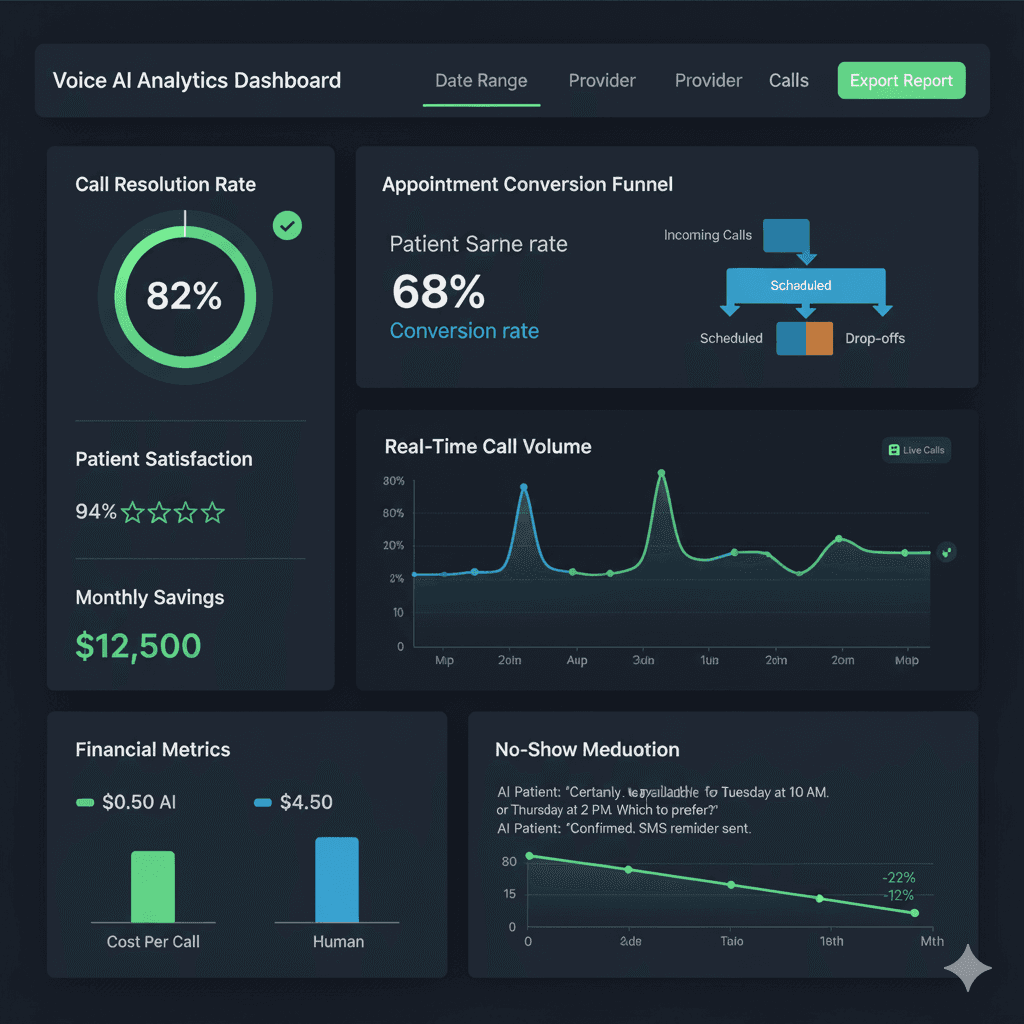
Call Resolution Rate: Percentage of calls handled successfully without needing transfer to a human agent. Target: 75-85%
Appointment Conversion Rate: Percentage of calls resulting in a booked appointment. Target: 65-75%
First-Call Resolution (FCR): Percentage of patient issues resolved during the initial call. Target: 80%+
Average Handling Time (AHT): The average duration of a call handled by the AI. Target: 2-3 minutes for scheduling.
Patient Satisfaction Score (PSAT): Measured through post-call surveys to gauge patient experience. Target: 90%+
Financial Metrics: Quantifying the ROI
Understanding the financial impact is critical for justifying your voice AI investment. Key financial metrics include:
Cost Per Call: Compare the cost of AI-handled calls vs. human-handled calls. Example: $0.50 (AI) vs. $4.50 (Human)
Revenue Per Call: Track the revenue generated from appointments booked through the AI.
No-Show Reduction (Month-over-Month): Measure the decrease in appointment no-shows attributed to AI-powered reminders.
After-Hours Revenue Capture: Quantify the revenue generated from appointments booked during non-business hours via the AI.
Monthly ROI Tracking: Monitor the overall return on investment of your voice AI implementation.
Operational Metrics: Optimizing Workflow and Staffing
Voice AI generates valuable data that can be used to refine operations:
Call Volume by Hour: Identify peak call times to optimize staffing levels.
Call Type Distribution: Understand the types of requests the AI is handling (e.g., appointment scheduling, prescription refills).
Transfer Rate: Percentage of calls that require transfer to a human agent. Target: 15-20%
Hold Time Elimination: Measure the reduction in patient hold times.
Multi-Language Usage: Track the utilization of different language options for diverse patient populations.
Real-Time Performance Dashboards: Actionable Insights at Your Fingertips
A robust real-time dashboard is essential for monitoring and managing voice AI performance. Key features include:
Live Call Monitoring with Transcripts: Observe calls in real-time and review transcripts to identify areas for improvement.
Daily Appointment Bookings (AI vs. Human): Compare booking performance between the AI and human agents.
No-Show Tracking with Reminder Effectiveness: Monitor no-show rates and assess the effectiveness of AI-powered reminders.
Cost Savings Calculator: Visualize the cost savings generated by the voice AI.
Patient Feedback: Access patient satisfaction scores and reviews in real-time.
Performance Benchmarks: Understanding Your Standing
Comparing your performance against industry benchmarks provides valuable context:
Top-Performing Practices (90th Percentile):
Call Resolution Rate: 85%
Appointment Conversion Rate: 72%
Patient Satisfaction Score: 95%
Average Practices (50th Percentile):
Call Resolution Rate: 78%
Appointment Conversion Rate: 65%
Patient Satisfaction Score: 91%
Strategies for Improving Low Metrics
If your voice AI is underperforming in certain areas, consider these improvement strategies:
Analyze Call Transcripts: Identify common issues that lead to call transfers or dissatisfaction.
Refine AI Training Data: Update the AI's knowledge base with new information and address identified knowledge gaps.
Optimize Call Flows: Simplify and streamline call flows to improve resolution rates.
Implement Proactive Reminders: Enhance appointment reminder strategies to reduce no-shows.
Solicit Patient Feedback: Actively seek patient feedback and use it to improve the overall experience.
Conclusion: Data-Driven Optimization for Voice AI Success
By consistently monitoring and analyzing these KPIs, medical practices can unlock the full potential of voice AI, improve patient experiences, and drive significant cost savings. A data-driven approach is crucial for optimizing performance, justifying investment, and ensuring long-term success.
About ConversAI Labs Team
ConversAI Labs specializes in AI voice agents for customer-facing businesses.