
Featured Article
Technology
The Technology Stack Behind ConversAI's Voice Agents
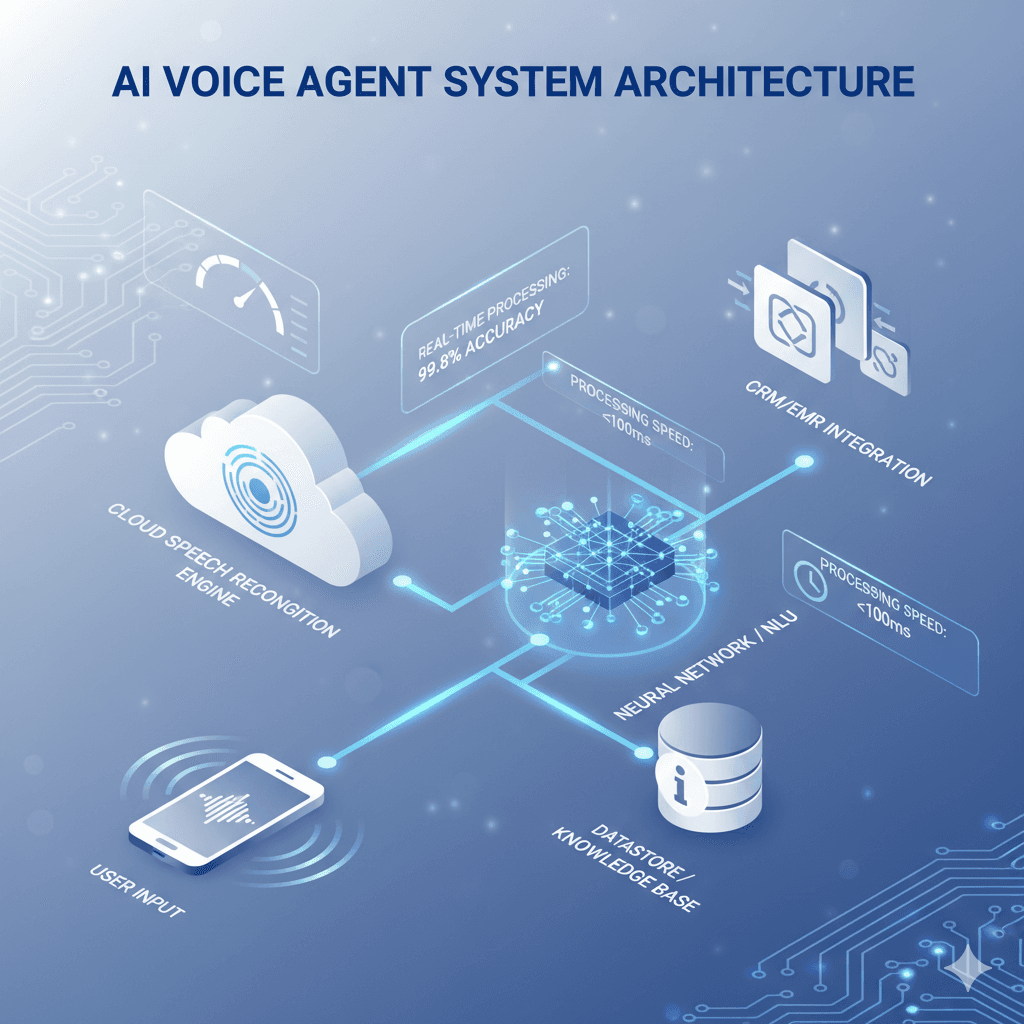
At ConversAI Labs, we build powerful and intelligent voice agents that revolutionize how businesses interact with their customers. Underpinning these seamless and engaging conversations is a sophisticated technology stack designed for reliability, accuracy, and scalability. This post delves into the core layers that power our AI voice agents, providing a comprehensive overview for CTOs, IT directors, and anyone interested in the technical intricacies of conversational AI.
Layer 1: Speech Recognition & Telephony Integration
The foundation of any voice agent is the ability to accurately transcribe spoken language into text. Our first layer focuses on bridging the gap between the analog world of voice and the digital realm of data.
VoIP Integration and Telephony Connectivity
ConversAI's voice agents seamlessly integrate with existing telephony infrastructure through Voice over Internet Protocol (VoIP). We utilize SIP (Session Initiation Protocol) trunking to establish reliable connections, allowing our agents to receive and initiate calls. For businesses relying on traditional phone lines, we also offer PSTN (Public Switched Telephone Network) connectivity options, ensuring a smooth transition to AI-powered voice solutions.
Speech-to-Text Accuracy
Accuracy is paramount. Our speech recognition engine boasts an impressive 98% accuracy rate, even in noisy environments. This is achieved through advanced noise cancellation algorithms that filter out background distractions, allowing for precise transcription of customer speech. We are constantly refining our models to improve accuracy further and adapt to various accents and speaking styles.
Multi-Language Support
Reaching a global audience is essential for many businesses. Our voice agents support over 100 languages, enabling you to communicate with customers worldwide in their native tongue. We continually update our language models to incorporate new languages and dialects, ensuring comprehensive global coverage.
Layer 2: Natural Language Understanding (NLU)
Once speech is converted to text, the next critical step is understanding the *meaning* behind the words. Our Natural Language Understanding (NLU) layer empowers our voice agents to decipher customer intent and extract relevant information.
Intent Classification and Entity Extraction
We use advanced machine learning models to classify the user's intent – what they are trying to accomplish. Simultaneously, we extract key entities, such as dates, times, product names, or locations. For example, if a user says, "Book a flight to London next Tuesday," the NLU layer identifies the intent as "book flight," extracts "London" as the destination, and "next Tuesday" as the date.
Context Management
Conversations are rarely one-off exchanges. Our voice agents maintain context across multiple turns of the conversation, remembering previous inputs and using them to interpret subsequent requests. This ensures a more natural and efficient interaction, reducing the need for users to repeat themselves.
Handling Interruptions, Corrections, and Clarifications
Real-world conversations are often unpredictable. Our NLU layer is designed to handle interruptions, corrections ("No, I meant Monday, not Tuesday"), and requests for clarification ("Did you say flights *to* London or *from* London?"). This robustness ensures that the conversation remains on track, even in the face of unexpected inputs.
Layer 3: Business Logic & Integration Layer
The real power of our voice agents lies in their ability to seamlessly integrate with your existing business systems. This layer connects the conversational interface to your critical data and processes.
Real-Time API Calls
Our agents can make real-time API calls to your CRMs, EMRs (Electronic Medical Records), booking systems, and other essential platforms. This allows them to access customer data, update records, and execute transactions on the fly. For instance, a voice agent can retrieve a customer's order history from your CRM or check appointment availability in your booking system.
Conditional Workflow Execution
Based on user input and data retrieved from external systems, our agents can execute conditional workflows. For example, if a customer is eligible for a discount, the agent can automatically apply it to their order. This flexibility allows you to automate complex business processes through voice.
Data Validation and Error Handling
We prioritize data integrity. Our agents validate user inputs and data retrieved from external systems to ensure accuracy. Robust error handling mechanisms are in place to gracefully manage unexpected situations and prevent data corruption.
Layer 4: Text-to-Speech & Voice Synthesis
The final layer focuses on generating a natural and engaging voice output that enhances the user experience.
Natural-Sounding Voice Generation
We utilize state-of-the-art text-to-speech (TTS) technology to generate human-like voices with natural prosody and intonation. This ensures that the voice agent sounds friendly, approachable, and easy to understand.
Custom Voice Options and Branding
We offer a range of custom voice options to align with your brand identity. You can choose from pre-defined voices or even create a unique voice that reflects your company's personality and values. This allows you to create a consistent and memorable brand experience across all communication channels.
Latency Optimization
Responsiveness is crucial. We have optimized our TTS engine to minimize latency, ensuring a response time of less than 500 milliseconds. This near-instantaneous feedback creates a fluid and engaging conversational experience.
Security & Compliance Architecture
Data security and compliance are non-negotiable. We have implemented a robust security architecture to protect sensitive information and adhere to industry regulations.
End-to-End Encryption
All data transmitted to and from our voice agents is protected with end-to-end encryption using AES-256. This ensures that your data remains confidential and secure at all times.
HIPAA, PCI-DSS, SOC 2 Compliance
We are committed to complying with industry-standard regulations, including HIPAA (for healthcare), PCI-DSS (for payment card information), and SOC 2 (for data security and availability). This ensures that our voice agents meet the stringent security requirements of various industries.
Data Residency and Privacy Controls
We offer data residency options to comply with local regulations and data privacy requirements. You have control over where your data is stored and processed, ensuring compliance with GDPR and other relevant privacy laws.
Performance Benchmarks & Technical Specifications
For detailed performance benchmarks and technical specifications regarding specific components of our technology stack, please contact our sales team or refer to our technical documentation. We are happy to provide tailored information to meet your specific requirements.
Common Technical Questions from CTOs and IT Directors
We frequently receive questions from CTOs and IT directors regarding the integration and deployment of our voice agents. Some common questions include:
How easily do your voice agents integrate with our existing CRM/EMR system?
What is the process for customizing the voice and personality of the agent?
What security measures are in place to protect patient/customer data?
What are the ongoing maintenance and support requirements?
Can you provide a detailed architecture diagram of the solution?
We are always happy to answer these and any other technical questions you may have. Please don't hesitate to reach out to our team.
API Documentation & Developer Resources
For developers interested in integrating our voice agents into their own applications, we provide comprehensive API documentation and developer resources. This includes code samples, tutorials, and SDKs to streamline the integration process. Visit our developer portal for more information.
About ConversAI Labs Team
ConversAI Labs specializes in AI voice agents for customer-facing businesses.