
Featured Article
Implementation
The Evolving Fraud Landscape in Banking and the Need for AI Voice Solutions
The banking industry faces an increasingly sophisticated and costly fraud landscape. The American Bankers Association (ABA) reported a staggering $28.6 billion in annual fraud losses for US banks in 2023. Alarmingly, account takeover (ATO) fraud has surged, with a 72% increase, and the voice channel has emerged as a particularly vulnerable point of entry. Social engineering attacks targeting call centers further exacerbate the problem. This necessitates robust, real-time fraud prevention measures during voice interactions, delivered without compromising the customer experience.
A Multi-Layered Approach to Fraud Detection in Voice AI Banking Systems
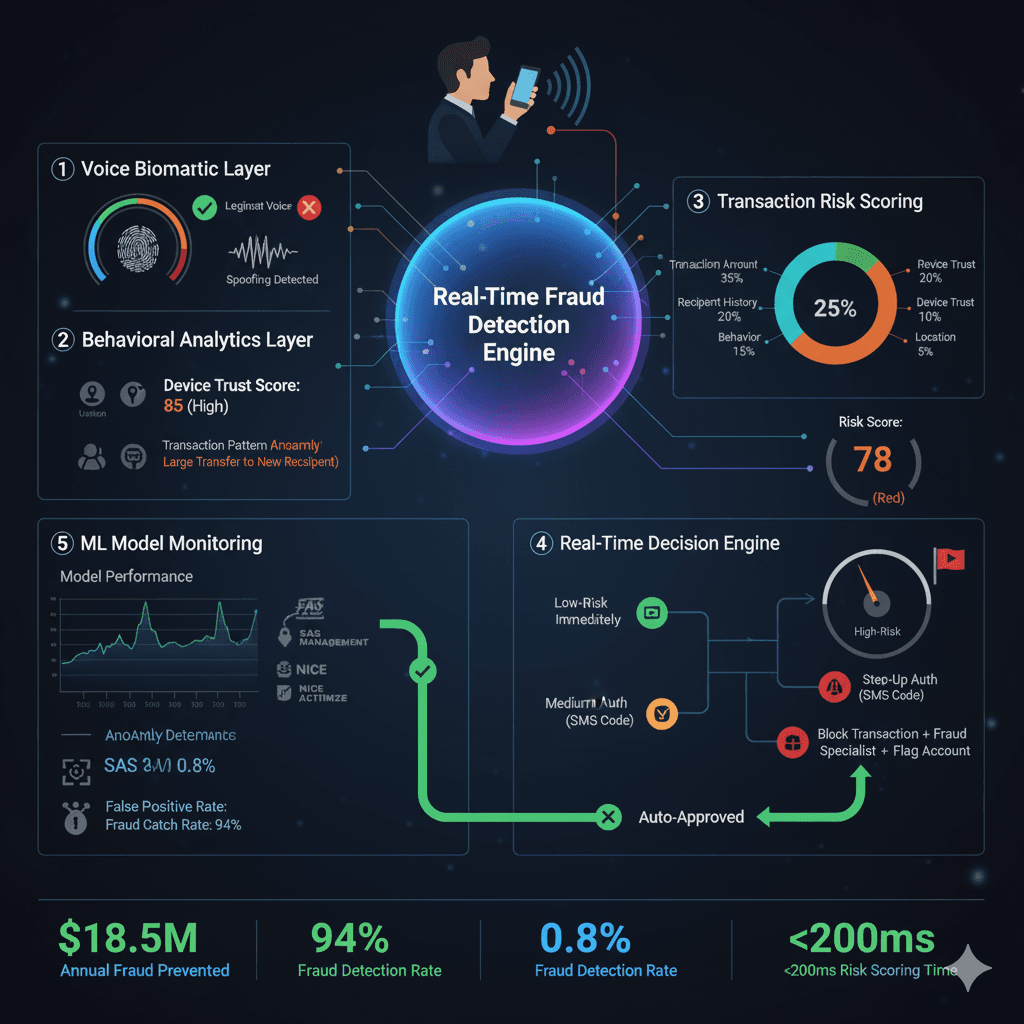
To effectively combat fraud in voice banking systems, a multi-layered approach is crucial. This approach should encompass the following key elements:
Authentication Layer: This layer focuses on verifying customer identity before granting access to sensitive information or enabling risky transactions. Key components include:
Voice Biometrics: Matching the caller's voiceprint against the enrolled voiceprint provides a highly accurate (up to 99.7%) method of authentication. Advanced liveness testing can detect recording playback and synthetic voice attempts.
Knowledge-Based Authentication (KBA): Utilizing familiar security questions such as account numbers, the last four digits of the Social Security number, or recent transaction details.
Out-of-Band Verification: For high-risk transactions, sending a one-time SMS code to the registered phone number adds an extra layer of security.
Behavioral Analytics: Analyzing user behavior to detect anomalies indicative of fraud. This includes:
Device Fingerprinting: Assessing the device used for the call. A known device with an established history signifies lower risk, while a new or unknown device warrants closer scrutiny.
Call Pattern Analysis: Monitoring the time, day, and location of calls. Deviations from typical patterns (e.g., a call at 2 AM from a different state, when the customer usually calls weekday mornings from their home area code) can trigger alerts.
Transaction Pattern Analysis: Evaluating transaction amounts, recipients, and frequency. For example, an attempt to transfer $5,000 to a new international account when the customer typically transfers $200-$500 to known payees should raise a red flag.
Transaction Risk Scoring: Assigning a real-time risk score to each transaction based on multiple factors:
Amount Risk: Transactions significantly exceeding the customer's typical amount receive a higher score.
Recipient Risk: Transfers to the customer's own account are low risk, while transfers to new external payees are medium risk, and international wires are high risk.
Timing Risk: Transactions occurring at unusual times of day or week are flagged.
Location Risk: Calls originating from known locations are considered lower risk than those from VPNs or with spoofed caller IDs.
Velocity Risk: Multiple transactions within a short timeframe can indicate fraudulent activity.
Anomaly Detection with Machine Learning (ML): Employing ML models to identify statistical outliers and unusual patterns:
Models are trained on millions of legitimate transactions to learn what constitutes normal behavior.
Clustering algorithms group similar fraud patterns, allowing for the detection of new and emerging threats.
Supervised learning models are trained on confirmed fraud cases to improve detection accuracy over time.
Fraud Detection Implementation: A Phased Approach
Implementing a fraud detection system within a voice AI banking environment requires a structured, phased approach:
Phase 1: Data Collection (2-3 weeks)
This phase focuses on gathering the necessary data to train and validate the fraud detection models. This includes:
Integrating with core banking systems to access transaction history (ideally a minimum of 12 months).
Ingesting data on confirmed fraud cases.
Collecting customer demographic and account information.
Establishing a dedicated data warehouse for fraud analytics.
Phase 2: Model Development (4-6 weeks)
This phase involves building and training the fraud detection models:
Analyzing historical fraud patterns to identify common indicators.
Developing a risk scoring model with weighted factors.
Training machine learning models on historical data (using a 70% training, 30% validation split).
Establishing risk thresholds (low 0-30, medium 31-70, high 71-100) based on the desired balance between fraud detection and customer friction.
Validating model performance (target: >90% fraud detection rate, <2% false positive rate).
Phase 3: Integration (3-4 weeks)
This phase focuses on integrating the fraud detection components with the existing banking infrastructure:
Integrating the voice biometric engine with enrollment and verification APIs.
Connecting to core banking APIs for real-time transaction data.
Integrating with existing enterprise fraud systems (e.g., FICO Falcon, SAS, NICE Actimize).
Building a real-time scoring engine with a latency requirement of <200ms.
Configuring automated response workflows.
Phase 4: Testing (2-3 weeks)
Thorough testing is essential to ensure the system's effectiveness:
Testing with known fraud scenarios to ensure detection.
Validating the false positive rate with legitimate test transactions.
Performance testing the scoring engine at call volume scale.
Security testing the fraud detection logic.
Conducting red team exercises to simulate internal fraud attempts.
Phase 5: Deployment (2 weeks)
Deployment should be gradual and carefully monitored:
Starting with a shadow mode deployment (scoring runs in the background without blocking transactions) to validate performance.
Gradually enforcing fraud detection rules, starting with the highest-risk transactions (e.g., wires >$10K).
Moving to full enforcement across all transaction types.
Continuously monitoring and tuning the system to optimize performance.
Specific Fraud Scenarios and Detection Methods
Different fraud scenarios require specific detection and response strategies:
Account Takeover (ATO):
Fraud: Attacker impersonates the customer using stolen PII to request a password reset or initiate unauthorized transfers.
Detection: Voice biometric mismatch, unusual request patterns, device unknown.
Response: Block authentication, transfer to a fraud specialist, flag the account for review.
Social Engineering:
Fraud: Attacker manipulates the legitimate customer into authorizing a fraudulent transfer.
Detection: Sentiment analysis detecting customer confusion, unusual transaction patterns, high amount.
Response: Step-up verification (callback to the number on file), agent transfer for complex transaction counseling.
Synthetic Identity Fraud:
Fraud: Attacker creates a fake identity using a combination of real and fabricated information to open an account.
Detection: Identity verification failure, behavioral anomalies, inability to enroll voice biometrics.
Response: Decline account opening, flag for fraud investigation, report to FinCEN if required.
Payment Fraud:
Fraud: Fraudster attempts unauthorized bill payments or external transfers.
Detection: New payee, unusually high amount, velocity check, location anomaly.
Response: SMS verification code, voice biometric confirmation, limit daily payment amount pending verification.
Fraud Detection Rules Examples
Here are some examples of fraud detection rules with corresponding logic:
Rule 1 (High-Risk Wire Transfer): IF transaction_type = "wire" AND amount > $10,000 AND recipient_country NOT IN ["USA", "Canada"] AND customer_wire_history_count < 3 THEN risk_score += 40, require manager approval.
Rule 2 (Account Takeover Pattern): IF voice_biometric_confidence < 85% AND password_reset_requested = TRUE AND caller_id_location != customer_state THEN risk_score = 95, block authentication, alert fraud team.
Rule 3 (Velocity Fraud): IF transaction_count_last_hour > 5 AND total_amount_last_hour > $2,000 AND customer_monthly_average_transactions < 15 THEN risk_score += 35, require step-up authentication.
Rule 4 (Device Anomaly): IF device_fingerprint NOT IN customer_known_devices AND session_location != customer_address_city THEN risk_score += 25, require out-of-band verification.
Leveraging Machine Learning for Anomaly Detection
Machine learning provides powerful capabilities for anomaly detection:
Unsupervised Learning: Algorithms like Isolation Forests and Autoencoders can identify transactions that deviate from the customer's normal patterns without requiring labeled fraud examples.
Clustering: Techniques like K-means and DBSCAN group similar customers and can detect outliers (e.g., a customer in a low-balance cluster suddenly making a large transfer).
Neural Networks: Deep learning models can be trained to recognize complex patterns using a large number of features.
Continuous Learning: Models should be updated weekly with new fraud patterns and false positive corrections.
Automated Fraud Response Workflows
Automated response workflows are crucial for handling different risk levels:
Low Risk (0-30 score): Process transaction immediately without friction, log for monitoring.
Medium Risk (31-70 score): Require step-up authentication (SMS code, security question, voice biometric challenge), transaction hold pending verification (60 seconds), agent-assist mode (AI stays on the call while agent verifies), reduce daily limits until verification.
High Risk (71-100 score): Block transaction immediately, transfer to a fraud specialist with full context, flag the account for review, alert fraud operations, and consider a temporary account freeze.
Integration with Existing Fraud Systems
Integrating with existing enterprise fraud platforms is essential for a unified fraud view:
Bidirectional integration with systems like FICO Falcon, SAS Fraud Management, and NICE Actimize.
Real-time risk score sharing.
Case management integration.
Fraud alert verification: outbound AI calls to customers.
Fraud Prevention Metrics and Key Performance Indicators (KPIs)
Key metrics for measuring the effectiveness of the fraud detection system include:
Fraud detection rate (% of actual fraud caught - target >90%).
False positive rate (% of legitimate transactions incorrectly flagged - target <2%).
Fraud loss prevented ($ value of blocked fraudulent transactions).
Customer friction score (% of customers experiencing additional verification).
Average detection time (milliseconds to score a transaction - target <200ms).
Model accuracy (precision and recall metrics monthly).
Return on Investment (ROI) of fraud prevention measures.
Tuning and Optimization for Continuous Improvement
Continuous tuning and optimization are essential for maintaining the system's effectiveness:
Weekly review of false positives to identify common patterns to whitelist.
Monthly fraud pattern analysis to update detection rules.
Quarterly model retraining with the latest data.
A/B testing of risk thresholds.
Feedback loop from the fraud team.
Regulatory Considerations
Compliance with relevant regulations is paramount:
Bank Secrecy Act (BSA) requiring suspicious activity reporting (SAR).
FinCEN requirements for fraud monitoring and reporting.
Fair Lending considerations.
Customer notification requirements (Reg E).
Implementation Checklist
A comprehensive implementation checklist ensures all critical aspects are addressed:
Fraud data warehouse established with 12+ months of history.
Risk scoring model developed and validated (>90% detection, <2% FP).
Voice biometric anti-spoofing configured and tested.
ML anomaly detection models trained and deployed.
Real-time scoring API achieving <200ms latency.
Fraud analyst dashboard and case management configured.
Response workflows automated (block, step-up, transfer).
Integration with enterprise fraud systems completed.
Fraud metrics dashboard created.
Security and compliance review passed.
About ConversAI Labs Team
ConversAI Labs specializes in AI voice agents for customer-facing businesses.