
Featured Article
ROI & Analytics
Unlocking Value: Data-Driven Voice AI Management in Banking
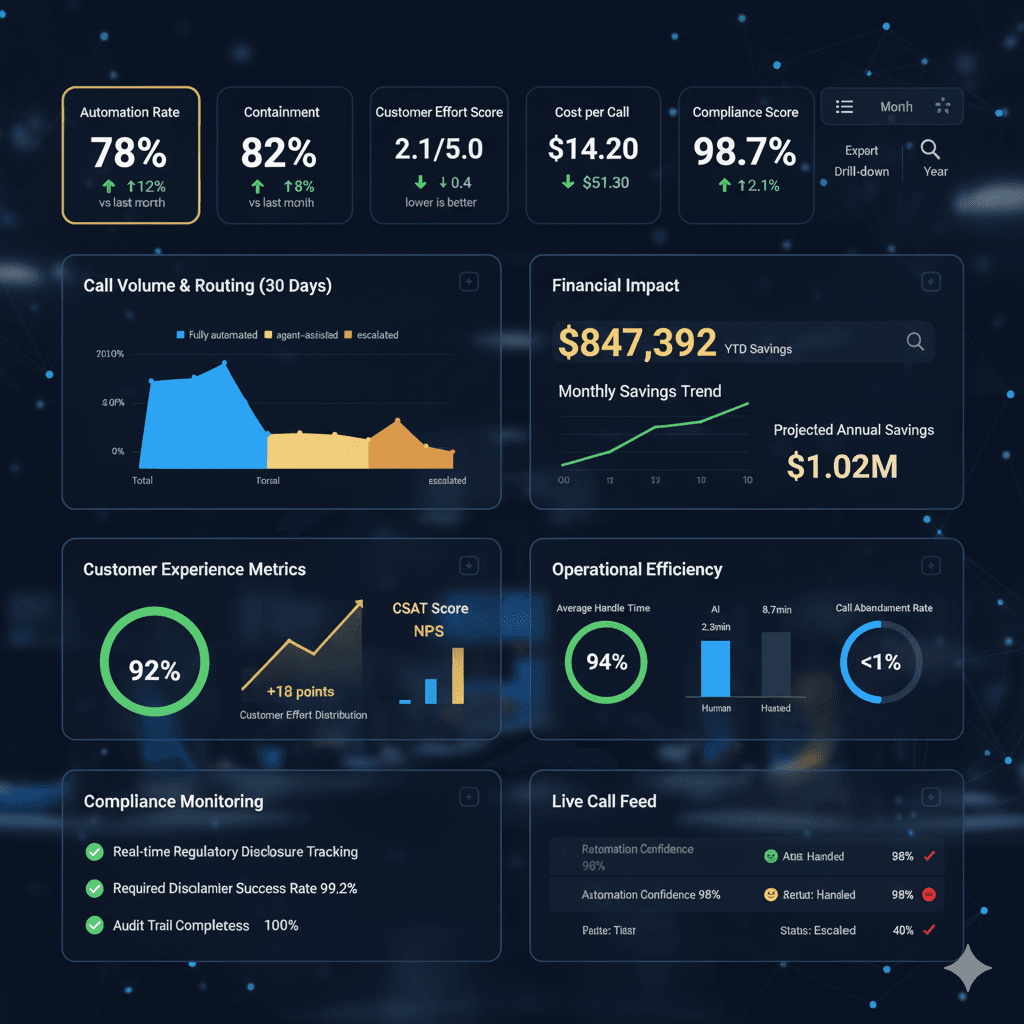
In the rapidly evolving landscape of banking, Voice AI agents are transforming customer interactions. What sets this apart from human-only operations? Unprecedented analytics on 100% of customer interactions. Data-driven management is not just a best practice; it's a necessity. As the adage goes: what gets measured gets improved.
Strategic KPIs for Executive Oversight
For executives, a clear understanding of the strategic impact is paramount. Here are the tier-1 KPIs to track:
Automation Rate: Percentage of calls fully handled by the AI without human intervention. Target: 65-80% (depending on bank complexity). Benchmark: Top quartile banks achieve 78%, median is 68%. Calculation: (Fully Automated Calls / Total Calls) * 100. Why it matters: Directly drives cost savings and is a primary indicator of ROI.
Containment Rate: Percentage of calls where the AI successfully addresses the customer's intent, even if a transfer is necessary for compliance or relationship reasons. Target: 75-85%. Benchmark: Top quartile at 84%. Difference from automation: It recognizes that partial assistance contributes to success.
Cost per Call: Total program cost (platform fees, integration, agent assist time) divided by total calls handled. Target: $8-15 (compared to $45-75 for human agents). Benchmark: Top quartile at $11.30.
Customer Effort Score (CES): Customer rating of ease of interaction (1-5 scale, lower is better). Target: <2.5. Benchmark: Voice AI averages 2.1 versus human average of 3.4. This is a key predictor of loyalty in banking.
Net Savings: Total cost reduction attributable to Voice AI minus the investment in the program. Target: Positive within 90 days. Benchmark: Median bank achieves $487K annually.
Operational KPIs for Performance Management
Operational managers require more granular data to optimize daily performance. Key tier-2 KPIs include:
Average Handle Time (AHT): AI: 2-3 minutes target vs. human 8-12 minutes. Tracks efficiency.
First-Call Resolution (FCR): AI: 90-95% target vs. human 75-85%. Measures effectiveness.
Transfer Rate: 15-25% target. Monitors appropriate escalation.
Intent Recognition Accuracy: 95%+ target. Tracks NLP performance.
Authentication Success Rate: 97%+ target for voice biometrics. Ensures security effectiveness.
Customer Satisfaction (CSAT): 90%+ target. Experience measurement.
Call Abandonment Rate: <2% target. Measures accessibility.
Compliance and Quality KPIs for Risk Mitigation
Banks operate in a highly regulated environment. Tier-3 KPIs focus on compliance and quality assurance:
Regulatory Disclosure Compliance: 99%+ delivery of required disclaimers. Automated compliance tracking is a significant advantage over human agents.
PCI-DSS Adherence: 100% secure payment handling with zero sensitive data exposure.
Audit Trail Completeness: 100% of calls logged with transcripts, satisfying regulatory requirements.
Sentiment Analysis: Proactive detection and escalation of negative sentiment for risk management.
Fraud Detection Rate: Identification of suspicious patterns to enhance security.
Real-Time Dashboards: Actionable Insights at a Glance
Real-time dashboards are essential for proactive management and rapid response. Key capabilities include:
Live call monitoring with AI confidence scores.
Drill-down from aggregated metrics to individual call transcripts.
Comparative analysis (AI vs. human performance, time periods, call types, customer segments).
Anomaly detection with automatic alerts (e.g., sudden CSAT drops, transfer spikes, compliance failures).
Customizable views tailored for different roles (executives, operations, compliance).
Data-Driven Performance Optimization Strategies
Turning data into action requires a strategic approach. Consider these optimization tactics:
Low Automation Rate (<60%): Analyze transfer reasons, expand AI capabilities for top transfer categories, and adjust confidence thresholds.
High CES (>3.0): Simplify authentication processes, reduce call steps, and improve NLP accuracy.
Low Containment Rate (despite good automation): Investigate partial completions, enhance intent confirmation, and improve error recovery mechanisms.
Compliance Score Drops: Review disclosure triggers, audit AI scripts, and retrain on regulatory requirements.
Banking-Specific Analytics: Contextual Understanding
Leverage analytics tailored to the banking industry to gain deeper insights:
Call distribution by type (balance inquiries, transfers, card services, etc.).
Channel analysis (phone vs. mobile app vs. web) comparing automation rates.
Customer segment performance (retail vs. commercial vs. wealth management).
Product-specific metrics (checking account calls vs. loan inquiries).
Geographic/branch performance comparison.
Benchmark Performance Tiers
Understand where your bank stands relative to the competition:
90th Percentile (Exceptional): 82% Automation, $9.50/call, 2.0 CES, 95% FCR, $825K Savings
75th Percentile (Strong): 76% Automation, $12.80/call, 2.3 CES, 92% FCR, $640K Savings
50th Percentile (Median): 68% Automation, $18.20/call, 2.7 CES, 88% FCR, $445K Savings
25th Percentile (Needs Improvement): 58% Automation, $24.50/call, 3.1 CES, 82% FCR, $280K Savings
Reporting Cadence and Audience
Establish a clear reporting structure to ensure accountability and informed decision-making:
Daily Operational Dashboard: For call center managers (handle time, call volume, transfer rates).
Weekly Performance Review: For VPs (automation trends, customer satisfaction, efficiency gains).
Monthly Executive Summary: For C-suite (financial impact, strategic KPIs, ROI tracking).
Quarterly Board Reporting: For business case validation, strategic recommendations, and competitive positioning.
About ConversAI Labs Team
ConversAI Labs specializes in AI voice agents for customer-facing businesses.