
Featured Article
Compliance
CCPA Compliance for Retail Voice AI: A Comprehensive Guide
The California Consumer Privacy Act (CCPA), effective January 2020 and amended by the California Privacy Rights Act (CPRA) in 2023, grants California residents significant privacy rights. Retailers leveraging voice AI systems that collect personal information from California customers must adhere to these regulations. With penalties reaching $2,500 per unintentional violation and $7,500 per intentional one, plus a private right of action for data breaches, CCPA compliance is not optional. Given California's substantial population (approximately 12% of the US) and its influence in setting national privacy standards, retailers serving California customers cannot afford to ignore CCPA.
Understanding CCPA Applicability to Retailers
A retailer is subject to CCPA if it meets ANY of the following thresholds:
Annual gross revenue exceeds $25 million.
Buys, sells, or shares the personal information of 100,000 or more California consumers or households annually.
Derives 50% or more of its revenue from selling personal information.
Most mid-to-large retailers will likely meet at least one of these criteria. Critically, voice AI systems inherently collect "personal information" as defined by CCPA, including:
Identifiers (name, phone number, email address).
Commercial information (purchase history, shopping behavior).
Audio recordings (voice recordings).
Inferences (about preferences, sizes, product interests).
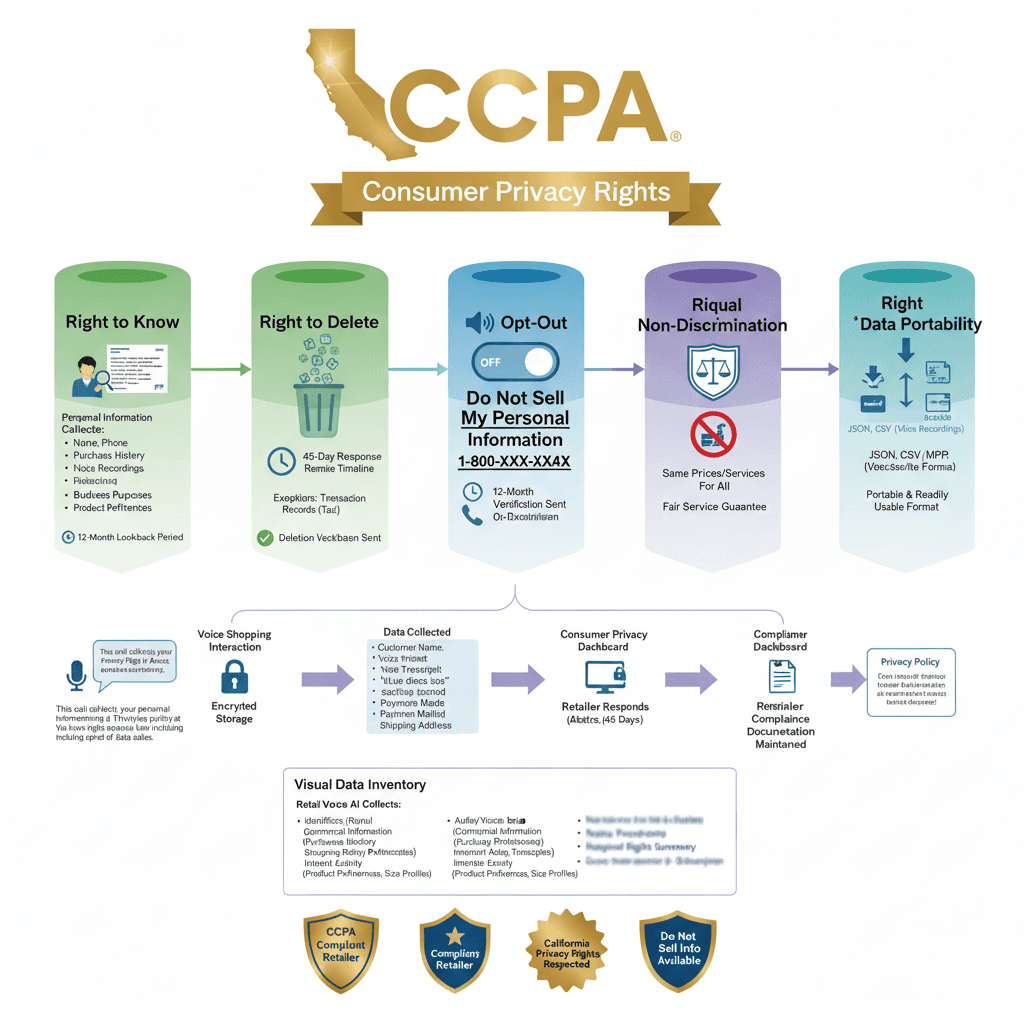
Five Core CCPA Consumer Rights & Retail Voice AI
Retail voice AI systems must be designed to fully support the following consumer rights:
Right #1: Right to Know
California consumers can request, up to twice per 12 months, the following information:
Specific pieces of personal information (PI) the retailer has collected about them.
Categories of PI collected.
Categories of sources (voice calls, website, mobile app).
Business/commercial purposes for collection (order processing, customer service, marketing, analytics).
Categories of third parties with whom the PI is disclosed (shipping carriers, payment processors, marketing platforms).
Retailers must respond within 45 days (extendable to 90 days with notice). Verification is required before disclosure (e.g., matching phone number + email address + recent order number). Data must cover the prior 12 months and be delivered by mail or electronically, according to the consumer's choice.
Voice AI Specifics: Retailers must provide voice call transcripts and a list of inferences made about the consumer (e.g., preferred sizes, product categories, shopping times).
Right #2: Right to Delete
Consumers can request the deletion of their PI. Retailers must delete the PI from their own records and direct their service providers to do the same. The response timeline is 45 days (extendable to 90 days). There are exceptions, permitting retention to:
Complete a pending transaction.
Detect security incidents or fraud.
Comply with legal obligations (e.g., 7-year tax records).
Internal uses reasonably aligned with consumer expectations.
Voice AI Specifics:
Delete voice recordings (retain no more than 90 days for quality/fraud purposes, then delete).
Delete call transcripts unless anonymized (remove name, phone number, and other identifiers).
Delete shopping preference inferences.
Maintain an audit log documenting the deletion request and compliance.
Send a deletion confirmation to the consumer.
Right #3: Right to Opt-Out of Sale/Sharing
Consumers can opt-out of the "sale" or "sharing" of their PI. "Sale" means disclosing PI to third parties for monetary or other valuable consideration. "Sharing" refers to cross-context behavioral advertising.
Retail Voice AI Sale Scenarios:
Selling customer shopping data to data brokers.
Sharing voice analytics with third-party platforms for payment.
Providing customer lists to marketing partners.
Required Opt-Out Mechanisms:
Prominent "Do Not Sell or Share My Personal Information" link on the website homepage (accessible within 2 clicks).
Toll-free phone number enabling voice opt-out (voice AI must handle: "I want to opt out of data sales").
No account creation required to opt-out.
Process requests within 15 business days.
Respect opt-outs for 12+ months before requesting opt-in.
For minors (<16 years old): Affirmative opt-in consent is required BEFORE any sale (not opt-out).
Right #4: Right to Non-Discrimination
Retailers cannot discriminate against consumers exercising their CCPA rights. This prohibits:
Denying goods or services.
Charging different prices or rates.
Providing different service levels or quality.
Suggesting the consumer will receive an inferior experience.
Financial incentive programs for data collection are permissible if reasonably related to the data's value (e.g., loyalty programs where consumers can opt-out and still shop). Different pricing is allowed if directly related to the value provided by the consumer's data.
Voice AI Implementation: Ensure the same voice shopping experience for opted-out customers, with no reduced service quality or "second-class" treatment.
Right #5: Right to Correct Inaccurate Information (CPRA Addition)
Consumers can request the correction of inaccurate PI. The response timeline is 45 days.
Voice AI Context: Correct wrong size preferences, fix mailing address errors, update product category interests.
CCPA Implementation Requirements for Retail Voice AI
Updated Privacy Policy: Must be readily accessible (including at the collection point through the voice AI greeting) and include:
Categories of PI collected ("We collect your name, phone, voice recording, purchase history, product preferences").
Business/commercial purposes ("for order processing, customer service, personalized recommendations").
Whether PI is sold/shared and the opt-out link.
Retention periods (voice recordings 90 days, transaction records 7 years).
Detailed list of PI categories: identifiers, commercial information, audio data, internet/electronic network activity, geolocation, inferences.
Consumer Request Infrastructure:
Multiple submission methods: dedicated email (privacy@retailer.com), toll-free number (voice AI can handle CCPA requests: "I want to know what data you have about me"), webform (easily accessible from the privacy policy).
Verification process (authenticate consumer before disclosing PI).
Request tracking system (logging submission date, type, response deadline, resolution).
Staff training on CCPA request types and processing.
Data Inventory and Mapping:
Comprehensive documentation of data elements, collection points, storage locations, data flows, retention schedules, and third-party disclosures.
Visual data map showing the PI lifecycle.
Vendor/Service Provider Management:
Data Processing Agreements (DPAs) with vendors handling PI.
Contractual prohibition on vendors selling the retailer's customer data.
Vendor obligation to assist with consumer requests.
Vendor CCPA attestation annually.
Vendor security requirements (encryption, access controls).
Voice AI-Specific CCPA Compliance Challenges & Solutions
Challenge: Voice recordings are inherently personal information. Solution: Encrypt in transit and at rest, implement automatic deletion after 90 days, provide audio file export for access requests, ensure secure deletion.
Challenge: Continuous data collection during calls. Solution: Clear disclosure at call start ("This call collects your voice and shopping information..."), capture verbal consent, log all privacy disclosures.
Challenge: Identifying California residents. Solution: Area code detection, ask state during account creation, conservatively apply CCPA protections nationally.
Challenge: Definition of "sale" ambiguous for analytics. Solution: Audit all third-party data sharing, assume sharing with analytics platforms that monetize data constitutes "sale", provide universal opt-out, negotiate contracts ensuring vendors don't sell customer data.
CCPA Compliance Implementation Roadmap
A suggested roadmap for implementing CCPA compliance for retail voice AI:
Phase 1 (Assessment - 3 weeks): Determine applicability, inventory PI, map data flows, identify data sales, gap analysis.
Phase 2 (Privacy Infrastructure - 6 weeks): Update privacy policy, create "Do Not Sell" webpage, implement consumer request mechanisms, build verification workflows, develop request tracking dashboard, create privacy preference center.
Phase 3 (Data Management - 5 weeks): Configure automated retention/deletion, implement data export functionality, anonymization pipelines, data correction workflows, audit logging.
Phase 4 (Vendor Compliance - 4 weeks): Review vendor contracts, negotiate DPAs, obtain compliance attestations, audit data handling, restrict vendor data sales contractually.
Phase 5 (Training and Documentation - 3 weeks): Train staff, document procedures, establish escalation procedures, quarterly privacy training refreshers, board/executive briefings.
Phase 6 (Ongoing Operations - continuous): Respond to consumer requests, quarterly policy reviews, annual compliance audit, monitor AG enforcement, track metrics.
Retail Voice AI CCPA Compliance Checklist
[ ] Privacy policy updated with CCPA-required disclosures.
[ ] "Do Not Sell or Share" link on homepage (prominent).
[ ] Privacy email address monitored.
[ ] Toll-free CCPA request number operational (voice AI enabled).
[ ] Webform for CCPA requests accessible and functional.
[ ] Consumer verification process documented and tested.
[ ] 45-day response SLA tracking system implemented.
[ ] Data inventory complete.
[ ] Data retention schedules configured.
[ ] Data export capability functional (JSON, CSV, MP3).
[ ] Anonymization procedures for retained analytics data documented.
[ ] Deletion procedures tested.
[ ] Opt-out mechanism functional (test with CA phone numbers).
[ ] Non-discrimination policy documented.
[ ] Vendor DPAs with CCPA terms executed.
[ ] Vendor compliance attestations received annually.
[ ] Staff trained on handling CCPA requests.
[ ] Voice AI greeting includes privacy disclosure.
[ ] Annual CCPA compliance audit scheduled.
The Expanding US Privacy Landscape
Beyond California, states like Virginia, Colorado, Connecticut, and Utah have enacted similar consumer privacy laws. While a national privacy law is still under consideration, retailers should consider applying consistent privacy protections nationwide for operational simplicity. Voice AI privacy best practices benefit all customers by ensuring transparent collection, minimal retention, strong security, easy rights exercise, and respect for preferences.
Enforcement and Penalties
The California Attorney General is the primary enforcement authority for CCPA. Penalties can reach $2,500 per unintentional violation and $7,500 per intentional violation. A 30-day cure period is granted before penalties for most violations. Data breaches trigger a private right of action ($100-$750 per consumer per incident), potentially leading to significant class action lawsuits. Furthermore, reputation damage from privacy violations can erode customer trust and create a competitive disadvantage. Proactive compliance is significantly cheaper than reactive remediation after a violation.
About ConversAI Labs Team
ConversAI Labs specializes in AI voice agents for customer-facing businesses.