
Featured Article
Compliance
Understanding Business Associate Agreements (BAAs) for Healthcare Voice AI
In the ever-evolving landscape of healthcare technology, voice AI offers powerful tools to enhance efficiency and patient care. However, when these technologies interact with Protected Health Information (PHI), a Business Associate Agreement (BAA) becomes essential. This guide provides a detailed overview of BAAs in the context of healthcare voice AI, empowering you to navigate the complexities and protect your practice.
What is a Business Associate Agreement?
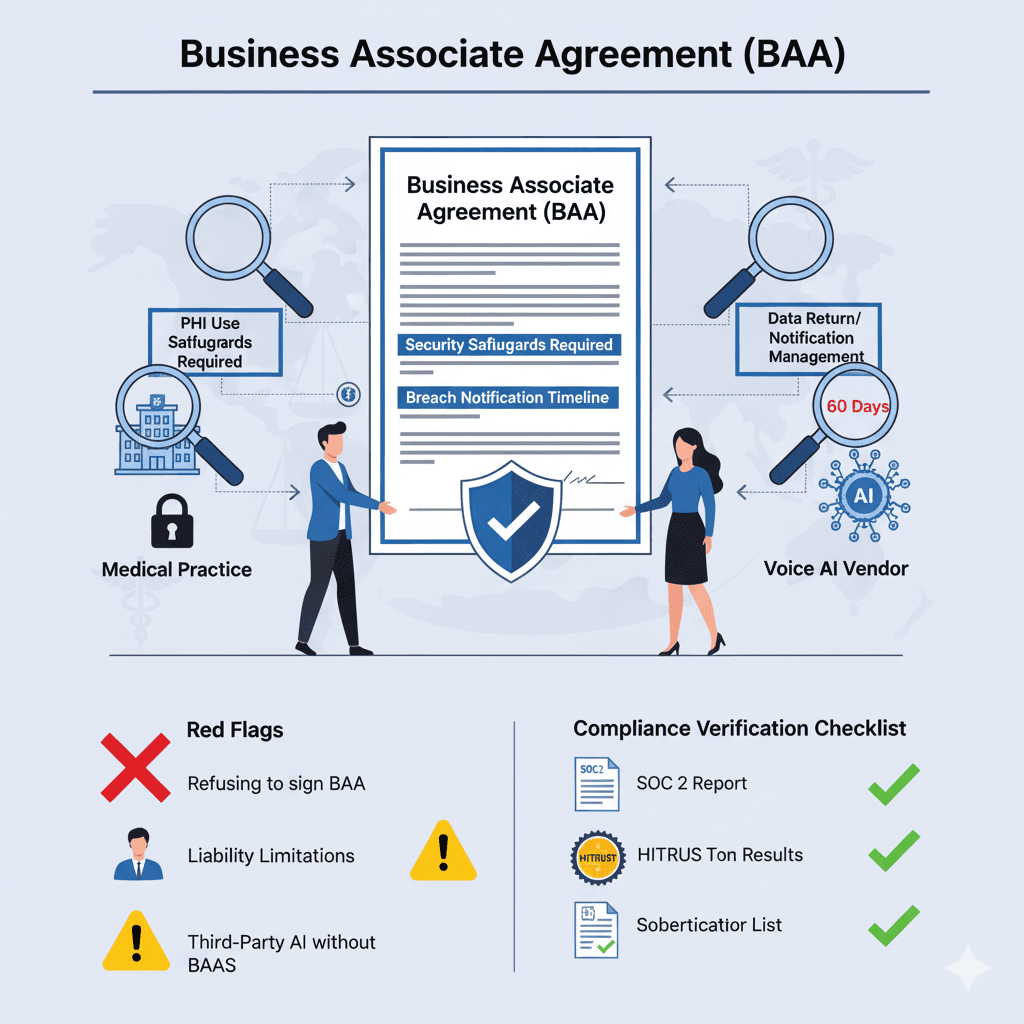
A Business Associate Agreement (BAA) is a legally binding contract mandated by the Health Insurance Portability and Accountability Act (HIPAA). It is required when a "covered entity" (like a medical practice) engages a "business associate" (like a voice AI vendor) who handles PHI on their behalf. The BAA outlines the responsibilities of both parties in safeguarding patient data.
When is a BAA Required for Voice AI?
A BAA is typically required when your voice AI vendor performs any of the following functions involving PHI:
Accessing Patient Information: If the AI system accesses patient names, phone numbers, appointment details, or other identifiable data to schedule appointments, send reminders, or provide personalized services.
Storing Call Recordings: If the system records patient conversations containing PHI.
EMR Integration: If the AI system integrates with your Electronic Medical Record (EMR) system and accesses, uses, or discloses PHI.
Automated Patient Outreach: If the AI system automatically contacts patients using PHI for appointment reminders, follow-up care instructions, or other communications.
When is a BAA NOT Required?
A BAA may not be necessary in the following situations:
Publicly Available Information: If the voice AI system only uses information already publicly available and does not identify specific patients.
De-identified Data: If the vendor only works with fully de-identified data that cannot be linked back to individual patients, and the vendor is contractually obligated to prevent re-identification.
Staff-Only Systems: If the system is solely used internally by staff, and the vendor does not have access to PHI. Note: This scenario is becoming less common as AI systems often involve remote access or data processing.
Key Components of a Business Associate Agreement
A comprehensive BAA should clearly define the obligations of the voice AI vendor and the rights of the medical practice. Key elements include:
Vendor Obligations:
Permitted Uses and Disclosures of PHI: Specifies how the vendor can use and disclose PHI, limiting it to the services outlined in the agreement.
Safeguards Against Unauthorized Access: Requires the vendor to implement appropriate administrative, technical, and physical safeguards to protect PHI from unauthorized access, use, or disclosure.
Breach Notification Procedures: Outlines the vendor's responsibility to report any security breaches or potential breaches to the practice promptly.
Return or Destruction of PHI: Specifies the vendor's obligation to return or destroy all PHI upon termination of the agreement.
Subcontractor Management: Requires the vendor to ensure that any subcontractors who handle PHI also have BAAs in place and adhere to the same security standards.
Practice Rights:
Right to Audit Vendor Security: Allows the practice to audit the vendor's security practices and policies to ensure compliance.
Access to Breach Reports: Grants the practice the right to access reports and information related to any security breaches or incidents.
Right to Terminate for Violations: Permits the practice to terminate the agreement if the vendor violates the terms of the BAA or HIPAA regulations.
Indemnification for Vendor Breaches: Protects the practice from financial losses resulting from the vendor's breach of the BAA.
Red Flags During BAA Negotiations
Be cautious of vendors who exhibit the following behaviors during BAA negotiations:
Refusal to Sign a BAA: A non-negotiable red flag. If a vendor refuses to sign a BAA when handling PHI, do not proceed.
Limiting Liability to Subscription Cost Only: Unacceptable, as it does not adequately protect the practice from potentially significant financial damages resulting from a breach.
Using Third-Party AI Without BAAs: Ensure the vendor has BAAs in place with any third-party AI providers they utilize.
Inability to Provide SOC 2 or HITRUST Certification: Indicates a lack of robust security controls.
Requiring the Practice to Indemnify Them: The BAA should protect the practice, not the vendor, from breaches.
BAA vs. HIPAA Compliance: Understanding the Difference
While a BAA is a crucial element of HIPAA compliance, it is not sufficient on its own. A BAA is a contractual agreement, but the vendor must also implement robust technical and administrative safeguards to protect PHI. This includes:
Technical Safeguards: Encryption, access controls, audit logs.
Security Certifications: SOC 2 Type II, HITRUST.
Compliance Documentation: Policies and procedures related to HIPAA compliance.
Regular Audits: Periodic security audits and risk assessments.
Vendor Verification Checklist
Before engaging a voice AI vendor, verify the following:
BAA Template: Review the vendor's BAA template carefully.
SOC 2 Type II Report: Request and review the vendor's SOC 2 Type II report.
HITRUST Certification: Check if the vendor has achieved HITRUST certification.
Penetration Test Results: Request recent penetration test results (redacted if necessary).
Subcontractor List with BAAs: Obtain a list of all subcontractors who will handle PHI and confirm they have BAAs in place.
BAA Renewal and Termination
BAAs should be reviewed and renewed periodically. Consider the following:
Annual Reviews: Review the BAA annually to ensure it remains current with evolving regulations and business practices.
30-Day Notice: Include a clause requiring a 30-day written notice for termination (or longer, depending on your risk tolerance).
60-Day PHI Removal: Specify a timeframe (e.g., 60 days) for the vendor to return or destroy all PHI upon termination.
Final Audit: Conduct a final audit upon termination to verify PHI removal.
6-Year Documentation Retention: Retain all BAA-related documentation for at least six years, as required by HIPAA.
About ConversAI Labs Team
ConversAI Labs specializes in AI voice agents for customer-facing businesses.