
Featured Article
Implementation
Why Proper Implementation Determines AI Voice Agent Success
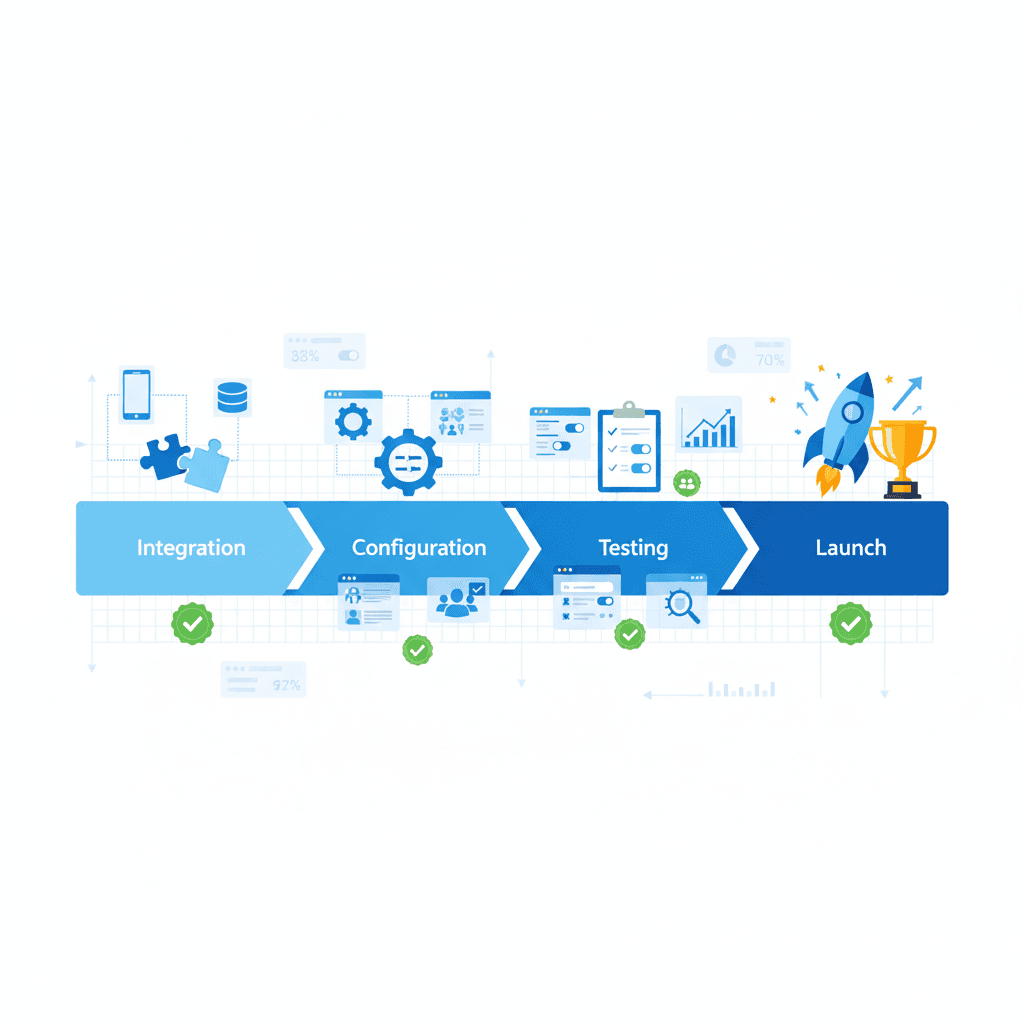
Artificial intelligence (AI) voice agents are revolutionizing customer service, sales, and internal operations across various industries. However, simply deploying an AI voice agent doesn't guarantee success. The key lies in a well-planned and executed implementation strategy. A poorly implemented AI voice agent can lead to frustrated customers, wasted resources, and a damaged brand reputation. This blog post outlines a comprehensive four-week implementation plan, along with best practices and common pitfalls to avoid, ensuring your AI voice agent becomes a valuable asset for your organization.
Pre-Implementation Phase (Week 0)
Before diving into technical details, a thorough pre-implementation phase is crucial for laying the foundation for a successful AI voice agent deployment.
Stakeholder Alignment and Goal Setting
Gather all relevant stakeholders (customer service, sales, IT, marketing, etc.) to align on the project's goals. What specific business problems are you trying to solve? What measurable improvements are you hoping to achieve? Examples include reducing call wait times, increasing sales conversions, or improving customer satisfaction scores. Clearly defined and agreed-upon goals will guide the entire implementation process.
Technical Requirements Audit
Assess your existing technical infrastructure to identify compatibility issues and necessary upgrades. This includes evaluating your CRM, EMR, DMS, phone system, and network infrastructure. Document all existing systems, APIs, and data sources that need to be integrated.
Use Case Prioritization
Identify the most impactful and easily implemented use cases for your AI voice agent. Start with simpler, high-volume tasks that can deliver quick wins. Examples include answering frequently asked questions, providing order status updates, or scheduling appointments. Prioritize use cases based on potential ROI and feasibility.
Success Metrics Definition
Establish specific, measurable, achievable, relevant, and time-bound (SMART) metrics to track the performance of your AI voice agent. Examples include:
Call resolution rate
Average handle time
Customer satisfaction score (CSAT)
Sales conversion rate
Cost savings
Week 1: System Integration & Data Migration
Week one focuses on connecting your AI voice agent to your existing systems and migrating the necessary data.
CRM/EMR/DMS API Integration
Integrate your AI voice agent with your CRM, EMR, or DMS systems via APIs to enable access to customer data, patient records, or document management. This allows the AI to provide personalized and informed responses. Ensure secure and reliable API connections are established.
Phone System (VoIP) Setup
Configure your VoIP phone system to route calls to the AI voice agent. This may involve setting up new phone numbers, configuring call routing rules, and testing the integration with your existing phone system. Consider using a Session Border Controller (SBC) for enhanced security and call management.
Data Import (Customer Records, Product Catalog)
Import relevant data, such as customer records and product catalogs, into the AI voice agent platform. This allows the agent to access and utilize this information during conversations. Ensure data is properly formatted and validated during the import process.
Security Configuration and Access Controls
Implement robust security measures to protect sensitive data. This includes configuring access controls, encrypting data in transit and at rest, and adhering to relevant compliance regulations (e.g., HIPAA, GDPR). Regularly audit security configurations to identify and address vulnerabilities.
Week 2: AI Agent Configuration & Training
In week two, you will configure your AI voice agent and train it to understand and respond to customer inquiries effectively.
Conversation Flow Design
Design clear and intuitive conversation flows that guide users through different scenarios. Use visual flowcharts or diagrams to map out the different paths users can take. Focus on creating natural and engaging conversations.
Intent Mapping and Entity Extraction
Map user intents (the goal of the user's request) to specific actions the AI agent can perform. Define entities (key pieces of information) that the AI agent needs to extract from user input to fulfill their requests. Example: Intent: "Schedule Appointment"; Entities: "Date," "Time," "Doctor Name."
Business Logic Configuration
Configure the business logic that governs how the AI agent interacts with your systems and data. This includes setting up rules for data validation, decision-making, and error handling.
Brand Voice and Tone Customization
Customize the AI agent's voice and tone to align with your brand identity. Ensure the AI agent's language and demeanor are consistent with your brand values. Consider using a professional voice actor to record the AI agent's prompts.
Multi-Language Setup
If applicable, configure the AI voice agent to support multiple languages. This involves translating conversation flows, training the AI agent on different languages, and implementing language detection capabilities.
Week 3: Testing & Pilot Launch
Week three is dedicated to rigorous testing and a limited pilot launch to validate the AI voice agent's performance in a real-world environment.
Internal Testing with Staff
Conduct thorough internal testing with staff to identify and fix bugs, usability issues, and performance bottlenecks. Provide staff with specific scenarios to test and encourage them to provide detailed feedback.
Pilot with 20-30% of Live Traffic
Launch the AI voice agent to a limited pilot group, typically 20-30% of your live traffic. This allows you to monitor performance in a controlled environment and make adjustments before full deployment.
A/B Testing Different Conversation Flows
Experiment with different conversation flows using A/B testing to optimize user experience and improve key metrics. Track the performance of different variations and identify the most effective approaches.
Performance Monitoring and Optimization
Continuously monitor the AI voice agent's performance, tracking key metrics such as call resolution rate, average handle time, and customer satisfaction. Identify areas for improvement and make adjustments to the conversation flows, training data, or business logic.
Week 4: Full Deployment & Go-Live
Week four marks the full deployment of the AI voice agent to all users.
Gradual Rollout to 100% Traffic
Gradually roll out the AI voice agent to 100% of your traffic, monitoring performance closely and making adjustments as needed. Avoid sudden changes that could disrupt the user experience.
Staff Training on AI Handoff Procedures
Train staff on how to handle calls that are transferred from the AI voice agent. Ensure staff are aware of the AI agent's capabilities and limitations and are prepared to provide seamless support to customers.
Customer Communication Strategy
Communicate the launch of the AI voice agent to your customers. Explain the benefits of the AI agent and provide clear instructions on how to use it. Be transparent about the AI agent's capabilities and limitations.
Go-Live Monitoring and Support
Provide ongoing monitoring and support to ensure the AI voice agent is performing optimally. Address any issues that arise quickly and efficiently.
Post-Launch Optimization (Ongoing)
The implementation process doesn't end with the go-live. Ongoing optimization is crucial for maximizing the value of your AI voice agent.
Conversation Analytics and Improvement
Analyze conversation data to identify areas where the AI voice agent can be improved. Look for patterns in user behavior, common pain points, and opportunities to streamline the conversation flows.
Intent Accuracy Tuning
Continuously tune the AI agent's intent recognition capabilities to improve accuracy. Add new training data to address gaps in the AI agent's knowledge and improve its ability to understand user requests.
New Use Case Expansion
Explore opportunities to expand the AI voice agent to new use cases. Identify additional tasks that can be automated and use the AI agent to provide even more value to your customers and employees.
Common Implementation Challenges & Solutions
Implementing an AI voice agent can present several challenges. Here are some common issues and their solutions:
Legacy System Integration Issues
Challenge: Integrating with older, less flexible systems can be complex and time-consuming.
Solution: Consider using middleware or API adapters to bridge the gap between the AI voice agent and legacy systems. Work closely with your IT team to ensure seamless integration.
Staff Resistance and Change Management
Challenge: Staff may be resistant to adopting the AI voice agent, fearing job displacement or questioning its effectiveness.
Solution: Communicate the benefits of the AI voice agent to staff, emphasizing that it will free them up to focus on more complex and rewarding tasks. Provide adequate training and support to help staff adapt to the new technology.
Call Quality and Latency Problems
Challenge: Poor call quality or latency can negatively impact the user experience.
Solution: Ensure you have a stable and reliable network infrastructure. Optimize your VoIP settings and consider using a Content Delivery Network (CDN) to reduce latency.
Implementation Checklist & Resource Guide
A comprehensive implementation checklist and resource guide will help you stay on track and ensure a successful deployment. This should include:
Detailed project plan with timelines and milestones
Roles and responsibilities for each team member
Documentation of all system integrations and configurations
Training materials for staff and customers
List of key performance indicators (KPIs) to track
Contact information for support and technical assistance
By following this comprehensive implementation plan, you can ensure that your AI voice agent becomes a valuable asset for your organization, improving customer service, streamlining operations, and driving business growth.
About ConversAI Labs Team
ConversAI Labs specializes in AI voice agents for customer-facing businesses.