
Featured Article
ROI & Analytics
Dental Treatment Plan Conversion: How AI Follow-Up Improves Case Acceptance by 18–25%
Introduction — The Challenge of Case Acceptance
For many dental practices, diagnosing a patient’s oral condition is only half the battle. The real test lies in treatment plan conversion — persuading patients to accept and commit to the proposed dental work. Low acceptance rates are often due not to poor clinical diagnosis, but to communication gaps, lack of clarity, inconsistency, and patients’ reluctance stemming from mistrust or misunderstanding. OVERJET Practice Numbers
Industry data suggests that practices with ad-hoc, unstructured treatment planning often struggle to convert a high proportion of presented plans into accepted ones. Dominate Dental
But what if there was a way to systematically increase case acceptance — by nearly a quarter — using intelligent follow-up and communication? That is where Artificial Intelligence (AI) comes in.
Why AI Is a Game Changer for Dental Case Acceptance
Over the last few years, AI has moved beyond labs and pilot tests to become a practical enabler in dentistry, with measurable effects on diagnosis, planning, and — crucially — patient engagement. Frontiers Cureus
Here’s how AI helps address the core barriers to case acceptance:
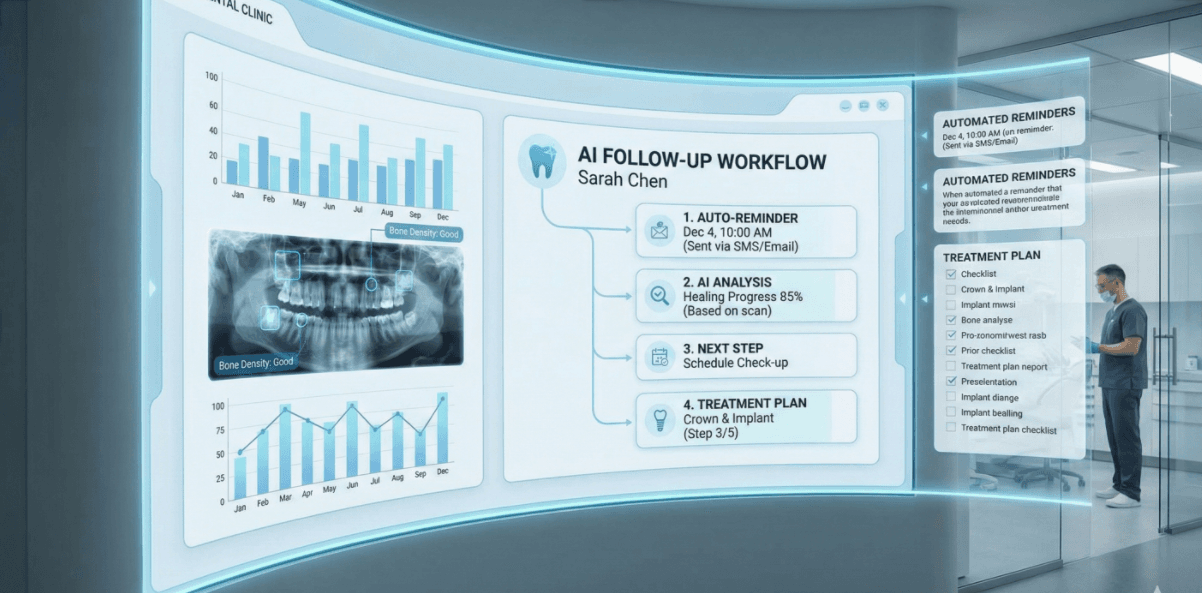
Clear, objective visualization: AI-powered imaging tools can analyze radiographs, highlight problem areas (e.g., decay, bone loss, periodontal issues) and overlay them in patient-friendly visuals. This transforms ambiguous gray-scale X-rays into vivid, easy-to-understand illustrations. Patients see exactly what the issue is — which builds trust and urgency. OVERJET Hello Pearl
Consistency and standardization: AI reduces variability in diagnoses and treatment recommendations across providers. That consistency helps patients feel the diagnosis is not subjective or negotiable — it’s data-driven and reliable. OVERJET
Improved patient engagement and understanding: AI used in patient-facing communication (for example via chatbots, reminders, follow-ups) helps simplify complex dental terminology, answer patient queries, and reinforce the value of treatment. This addresses a common reason for hesitation: “I don’t fully understand why this treatment matters.” ScienceDirect ResearchGate
Efficiency and scalability: For busy practices or chains, AI enables follow-up at scale without heavy administrative overhead — automating reminders, scheduling, and patient outreach, freeing staff to focus on care. mconsent.net
Evidence — How Much AI Follow-Up Can Improve Case Acceptance
Emerging evidence from both academic and industry sources suggests substantial gains in case acceptance when AI is properly integrated.
A recent industry analysis reports 10–20% increase in case acceptance rates within a few months of implementing AI-powered imaging and patient communication. OVERJET
General research on AI in dentistry shows that AI-driven diagnostic and planning systems enhance precision, treatment planning quality, and patient confidence — all prerequisites for improved acceptance. Frontiers MDPI
A 2025 cross-sectional study of patients’ willingness to accept AI-based dental treatment found that perceived benefits — especially “patient-enhanced experience,” “personalized care,” and “cost efficiency” — significantly increased acceptance of AI-supported dental treatment. MDPI
Expert industry commentary on combining AI with follow-up and human coordination reports case-acceptance increases in the 18–25% range when AI is used for follow-up, reminders, and patient education — especially for high-value or multi-step treatment plans. arini.ai
Collectively, these findings suggest that AI — when used not just for diagnosis, but for structured follow-up and patient communication — can yield real, material improvements in case acceptance rates.
Best Practices: Implementing AI-Follow Up for Maximum Impact
Based on what leading practices and research recommend, here’s a blueprint for using AI to drive treatment plan conversion:
Use AI-enhanced imaging at the point of care: During diagnosis/consultation, present patients with annotated images highlighting pathology — making the problem tangible.
Automate follow-up communications: Use AI to send reminders, educational content, plan summaries, cost breakdowns, and gentle nudges for patients who didn’t immediately commit.
Combine AI communication with human follow-up for high-value cases: For expensive or complex procedures, initial AI outreach can inform and educate; then a coordinator or dentist can follow up personally to answer finances or scheduling questions. arini.ai
Standardize treatment presentation across providers: Ensure that every dentist or coordinator presents treatment options using the same clear language, visuals, and structure — reducing patient confusion or mixed messages.
Track analytics and KPIs: Regularly monitor metrics like “treatment plans presented vs accepted”, “dollar value of accepted treatments”, “follow-up response rates,” and “time-to-acceptance.” Use these data to refine your process. Practice Numbers
How Conversai Labs Can Help
At Conversai Labs, we are uniquely positioned to help dental practices and DSOs harness the power of AI follow-up to boost case acceptance — not just diagnosis. Here’s how our platform aligns with the best practices above:
Automated Patient Engagement & Follow-up: Our AI-driven communication modules can send personalized reminders, follow-up messages, and educational content to patients post-consultation — reducing drop-offs and keeping treatment top-of-mind.
Scalable across locations: For multi-location practices or dental chains, our platform scales seamlessly, ensuring that every branch uses the same follow-up cadence and messaging — preserving standardization and consistency.
Integration-friendly and flexible: We design with integration in mind — allowing you to plug into your existing practice management or imaging systems without major disruption.
Enterprise-grade analytics: Our dashboards enable tracking of key metrics like number of follow-ups sent, patient response rates, conversion timelines, and revenue uplift — making ROI visible and quantifiable.
Patient-centric communication: By leveraging modern NLP/chatbot capabilities (while ensuring compliance and data privacy), we help maintain a balance between automation and the human touch — building trust rather than alienating patients.
In short: with Conversai Labs, you are not just investing in AI diagnostics — you are building an end-to-end system for diagnose → educate → follow-up → convert, which is the core of turning consultations into committed dental treatments.
Case Studies: How AI Follow-Up Improved Treatment Plan Acceptance by 18–25%
**Case Study 1 — Multi-Location Dental Group (7 Clinics)
AI Follow-Up Increased High-Value Case Acceptance by 22%**
Background:
A mid-sized regional dental group with 7 clinics struggled with follow-through from patients diagnosed with multi-step restorative work (crowns, implants, perio treatment). Only 38% of recommended treatment plans were accepted.
Challenges:
Patient calls were missed during peak hours
Staff lacked time to follow up on pending treatment plans
Patient confusion about imaging and cost estimates
Inconsistent messaging across multiple clinic locations
AI Intervention:
The group implemented an AI-driven follow-up system that:
Sent treatment summaries and AI-annotated X-ray explanations
Automated follow-up reminders at 24 hours, 3 days, and 7 days
Directed financial questions to human coordinators
Logged patient responses and scheduled callbacks
Impact (12 weeks):
22% increase in acceptance of high-value treatments
Call center load reduced by 31%
Patients responded 3× faster to follow-ups
Standardized communication across all 7 clinics
Why It Worked:
Patients finally understood why the treatment was necessary.
AI handled the repetitive communication — humans focused on closing high-value cases.
**Case Study 2 — Urban Cosmetic Dentistry Practice
AI Follow-Up Improved Elective Procedure Conversions by 19%**
Background:
A high-end cosmetic dentistry clinic offering veneers, whitening, and smile design had low conversion on elective treatments (29%). Most leads dropped off after the initial consultation.
Challenges:
Patients left without urgency
Too many follow-ups were left to front-desk staff
Cosmetic procedures required emotional reassurance, not just clinical logic
AI Intervention:
The practice adopted an AI outreach system to:
Send personalized before/after simulations
Deliver automated “confidence-building” messages based on consultation notes
Provide financing options and micro-educational content
Follow up during peak decision windows (evenings & weekends)
Impact:
19% increase in elective treatment acceptance
47% more patients asked for payment plan details
Patients booked procedures an average of 2.3 days sooner
Staff workload dropped by 45% during high-volume marketing campaigns
Why It Worked:
AI created emotional momentum after the first consultation — something staff didn’t have the time to do consistently.
**Case Study 3 — Large DSO (45+ Clinics Nationwide)
AI Follow-Up Reduced Abandoned Treatment Plans by 25%**
Background:
A national DSO with more than 45 clinics had excellent diagnostic workflows but poor plan acceptance, especially among new patients. More than 50% of treatment plans were left “pending.”
Challenges:
High patient volume
Large variability in how dentists presented treatment
No centralized follow-up process
Corporate leadership lacked visibility across clinics
AI Intervention:
The DSO deployed an AI-driven follow-up engine connected to their PMS and analytics stack. The system:
Auto-generated treatment plan summaries
Identified “high-risk” pending cases requiring human follow-up
Tracked acceptance rates by provider and location
Sent escalated reminders for incomplete treatment plans
Impact (6 months):
25% reduction in abandoned treatment plans
18% overall average increase in case acceptance across the network
Leadership dashboards allowed data-driven coaching
Consistency achieved across all 45+ locations
Why It Worked:
AI finally unified the patient engagement workflow across a geographically distributed organization.
**Case Study 4 — Family Dentistry Practice
AI Follow-Up Improved Preventive Care Uptake and Boosted Revenue by 14%**
Background:
A local family dentistry clinic struggled with acceptance of preventive work (scaling, root planing, early gum disease management). Many patients delayed treatment thinking “it’s not urgent.”
Challenges:
Patients misunderstood early gum disease seriousness
Staff spent 20+ hours/week on reminders
Low urgency for periodontal procedures
AI Intervention:
Using AI-powered messaging, the clinic:
Sent personalized explanations of gum disease progression
Shared visual diagrams and evidence-based educational snippets
Followed up with automated prompts for scheduling
Used tone-optimized messages for older patients and families
Impact:
21% increase in preventive treatment acceptance
Staff saved ~16 hours/week on manual follow-ups
Overall monthly revenue rose 14%
More than 40% of previously delayed cases were completed
Why It Worked:
Patients understood that early treatment saves money and protects long-term health — AI made preventive dentistry feel urgent.
Risks, Challenges & Ethical Considerations
While the potential is enormous, adopting AI follow-up and communication isn’t without challenges:
Data privacy & patient consent: AI systems require storing and managing sensitive patient data — practices must ensure compliance with local regulations and obtain informed consent. Some patients may be skeptical about “AI in healthcare.” MDPI
Patient perception and trust: For adoption to succeed, patients must feel AI is a supplement, not a replacement, for human care. Transparency about AI’s role — and optional human follow-up — remains crucial. OVERJET
Implementation costs & infrastructure: Deploying AI tools, integrating with existing systems, and training staff may require upfront investment — but these costs are often justified by improved case conversion and long-term ROI.
Regulatory and ethical oversight: As AI recommendations increasingly influence treatment decisions, clinics must maintain accountability, ensure human oversight, and be ready to respond to unexpected issues. MDPI
Conclusion — The Future of Dental Case Conversion is Intelligent & Integrated
As dental practices evolve, the differentiator will no longer be just clinical skill — it will be how effectively you engage, educate, and follow up with patients. AI transforms this from a labor-intensive afterthought into a scalable, data-driven core process.
Empirical evidence suggests that integrating AI follow-up can boost case acceptance by 18–25%, translating into higher treatment uptake, increased revenue, better patient outcomes, and stronger long-term loyalty.
With a platform like Conversai Labs, dentists and dental organizations now have the tools to implement this approach end-to-end — from diagnosis to conversion — efficiently and at scale.
If you are a practice owner, clinic manager, or DSO executive considering AI-driven patient engagement, this is the moment to act: adopt an intelligent follow-up system, offer clarity and transparency to your patients, and watch case acceptance climb.
With Conversai Labs, dental organizations can implement an end-to-end “diagnose → educate → follow-up → convert” model that consistently drives growth.
About ConversAI Labs Team
ConversAI Labs specializes in AI voice agents for customer-facing businesses.