
Featured Article
Implementation
Implementing Voice AI with Your EMR: A 30-Day Guide
Integrating a Voice AI agent with your Electronic Medical Record (EMR) system can significantly streamline your practice's operations, reduce administrative burden, and improve patient experience. This guide outlines a structured 30-day implementation plan, designed to ensure a smooth and efficient deployment without disrupting your daily workflow.
The 30-day timeframe allows for thorough testing, configuration refinement, and comprehensive staff training, resulting in a successful and optimized Voice AI integration.
Why 30 Days? A Phased Approach
A phased, 30-day approach to EMR integration with Voice AI offers several key advantages:
Minimized Disruption: Gradual rollout prevents sudden changes to workflows, allowing staff to adapt progressively.
Thorough Testing: Ample time for rigorous testing ensures data accuracy and identifies potential issues early.
Optimized Configuration: Real-world data informs fine-tuning of conversation flows and system parameters.
Effective Training: Provides adequate time for staff training and familiarization with the new system.
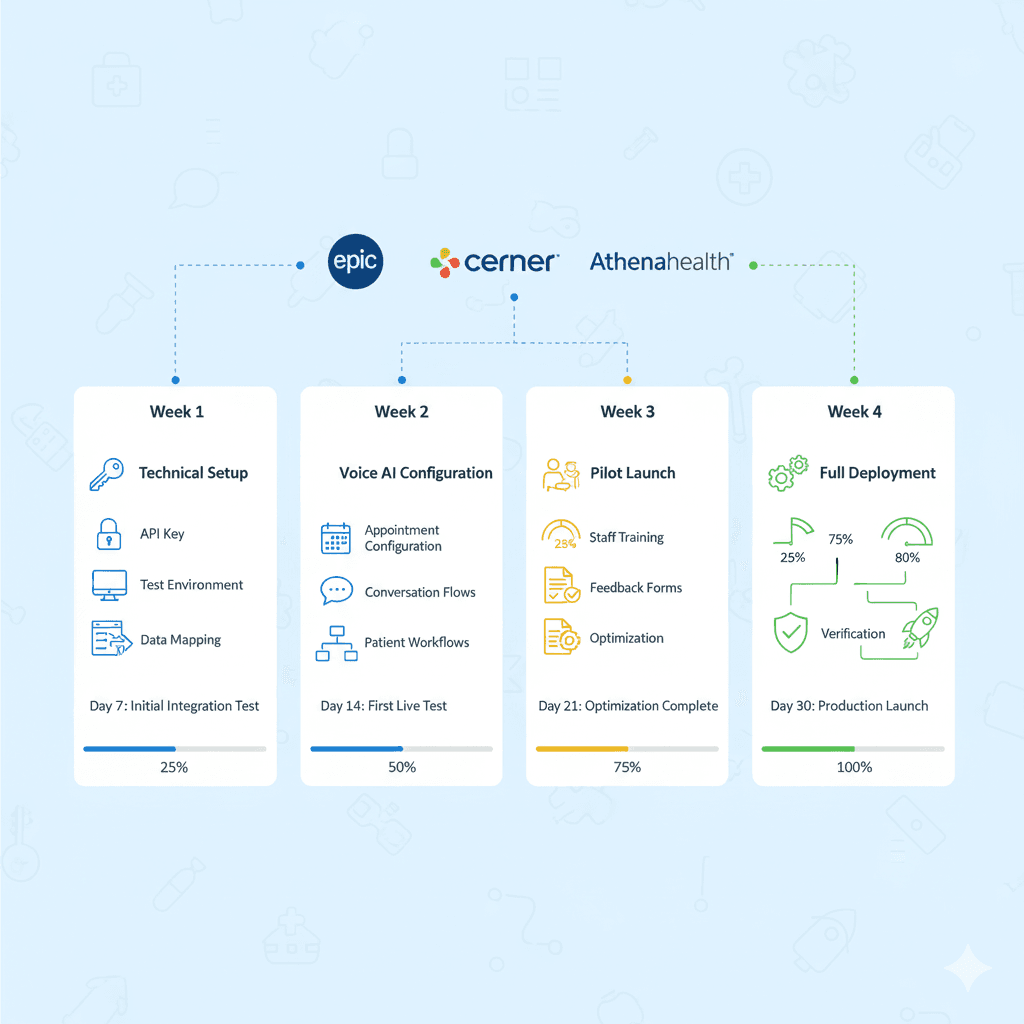
Week 1: Technical Setup & API Configuration
This week focuses on establishing the connection between your EMR and the Voice AI platform. Accurate configuration here is crucial for subsequent steps.
Days 1-2: API Credential Acquisition & Configuration:
Request API credentials (API key, secret key) from your EMR vendor.
Configure OAuth 2.0 authentication for secure access.
Establish a dedicated test environment to prevent impacting live data.
Days 3-4: Data Mapping and Configuration:
Map relevant EMR fields (patient demographics, appointment details, insurance information) to corresponding Voice AI fields.
Configure provider calendars and supported appointment types within the Voice AI system.
Perform initial import of patient demographics into the Voice AI system.
Days 5-7: Read-Only Testing & Documentation:
Conduct thorough testing of read-only operations, such as retrieving patient information and appointment schedules.
Verify data accuracy between the EMR and Voice AI system.
Document any issues encountered and their corresponding solutions.
Week 2: Voice AI Configuration & Workflow Design
Week two involves configuring the Voice AI's behavior and designing the conversation flows it will use.
Days 8-10: Appointment & Availability Configuration:
Configure appointment type rules within the Voice AI system (e.g., allowed scheduling windows, required information).
Set provider availability patterns, including working hours and vacation schedules.
Configure buffer times between appointments to prevent overlap.
Days 11-13: Conversation Flow Development:
Build intuitive conversation flows for common tasks, such as appointment scheduling, prescription refills, and insurance verification.
Configure insurance verification processes within the Voice AI workflow.
Set up routing logic for prescription refill requests to the appropriate staff member.
Day 14: End-to-End Workflow Testing:
Process 5-10 test appointments through the complete Voice AI workflow, from initial contact to EMR updates.
Week 3: Pilot Launch & Refinement
This week marks the beginning of real-world usage, starting with a pilot launch to a limited number of users.
Days 15-17: Staff Training & Support Preparation:
Train front desk staff on how to monitor the Voice AI dashboard and handle escalated calls.
Review escalation procedures for situations requiring human intervention.
Provide staff with a comprehensive FAQ document addressing common questions.
Days 18-21: Pilot Launch & Monitoring:
Route 25% of incoming calls to the Voice AI agent.
Monitor resolution rates, transfer rates, and call durations through the monitoring dashboard.
Collect feedback from staff and patients regarding their experiences.
Days 22-24: Refinement & Optimization:
Refine conversation flows based on real-world data and user feedback.
Add support for any missing appointment types identified during the pilot phase.
Improve transfer logic to ensure seamless handoffs to human agents.
Week 4: Full Deployment & Final Configuration
The final week involves scaling up the Voice AI's usage and completing the final configuration.
Days 25-27: Scaled Deployment & Continued Training:
Scale the Voice AI's usage to 75% of incoming calls.
Monitor EMR data accuracy closely to ensure seamless integration.
Provide ongoing staff training and support as needed.
Days 28-29: Audit & Compliance:
Audit EMR records to verify data integrity and accuracy.
Review HIPAA compliance measures to ensure patient data privacy.
Document the final Voice AI configuration for future reference.
Day 30: Full Production Launch:
Launch the Voice AI agent into full production, handling 80-90% of incoming calls.
Technical Requirements Checklist
Ensure you have the following in place before beginning the implementation:
Access to EMR API documentation
EMR API credentials (API key, secret key)
Development/test environment for EMR
Secure server for hosting Voice AI
SSL certificate for secure communication
Reliable internet connection
Dedicated IT resource for technical support
Staff with understanding of EMR workflows
Monitoring dashboard setup
Backup and recovery plan
Common Challenges & Solutions
API Rate Limits: Some EMR systems have rate limits on API requests. Solution: Implement caching mechanisms to reduce the number of API calls.
Custom EMR Fields: Your EMR may contain custom fields not natively supported by the Voice AI platform. Solution: Carefully map these custom fields to appropriate Voice AI fields during Week 1.
Multiple EMR Systems: If your practice uses multiple EMR systems, each one will require a separate integration. Solution: Prioritize the integration based on call volume and business needs, then implement separate integrations for each system.
Post-Launch Support & Optimization
The implementation doesn't end after 30 days. Ongoing monitoring and optimization are crucial for maximizing ROI.
Weeks 5-8: Ongoing Optimization: Conduct daily monitoring of Voice AI performance, identify areas for improvement, and refine conversation flows accordingly.
Months 2-3: ROI Tracking: Track key performance indicators (KPIs) such as call volume handled by the Voice AI, reduced call handling times, and improved patient satisfaction to measure the return on investment.
About ConversAI Labs Team
ConversAI Labs specializes in AI voice agents for customer-facing businesses.